
MSRP: $1,749.90 (Complete Bundle)
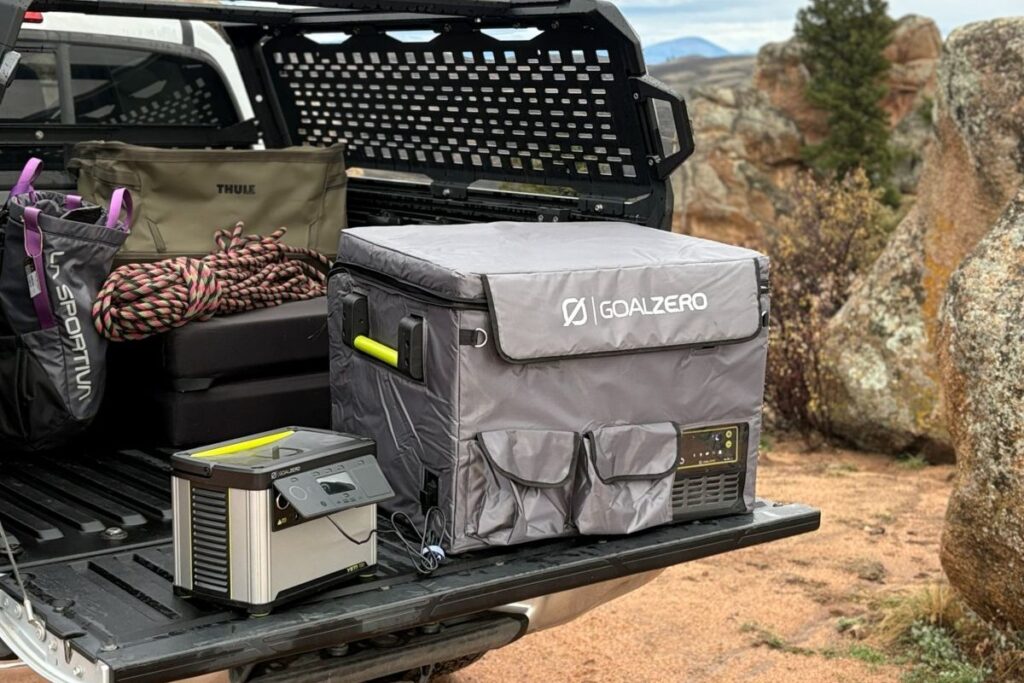
A friend of mine spent a few years buying and selling different camping rigs: a pull-behind camper, a slide-in truck camper, a rooftop tent and a converted van. His conclusion after all that inconclusive trial and error was that there is no perfect rig but if you want to make one upgrade to your setup that matters, start with an electric cooler paired with a solar power station. After eight weeks with Goal Zero’s Yeti 700 power station, Alta 50 electric cooler and Nomad 100 solar panel, I agree.
I’m happy enough sleeping in a tent, I prefer to cook outside and I don’t mind “roughing it” without a built-out Sprinter van, but adding solar electric power and getting rid of the melting ice and the soggy food in a standard cooler made every trip better. With a solar electric fridge, food stays dry and cold, and there’s no ice to buy or drain.
I chose Goal Zero after some research for a few reasons. The company makes every component needed, so the power station, fridge and panel plug together with included cables, no questions, and the system can be controlled with the Goal Zero app. Goal Zero also has a reputation for durability, and the sixth-generation Yeti 700 carries the company’s latest battery and electronics. I wanted to keep the system small and light, so I picked the 677-watt-hour Yeti 700 power station, the smaller of Goal Zero’s two Alta coolers and a portable 100-watt solar panel.
Setup was about as easy as it gets. It took me fewer than 10 minutes to unbox everything, plug it in and have it running. Goal Zero makes larger and more powerful options for each component. For my purposes, I was happy with my choice to stay lighter and smaller.
Here’s the details for each component:
Yeti 700 power station
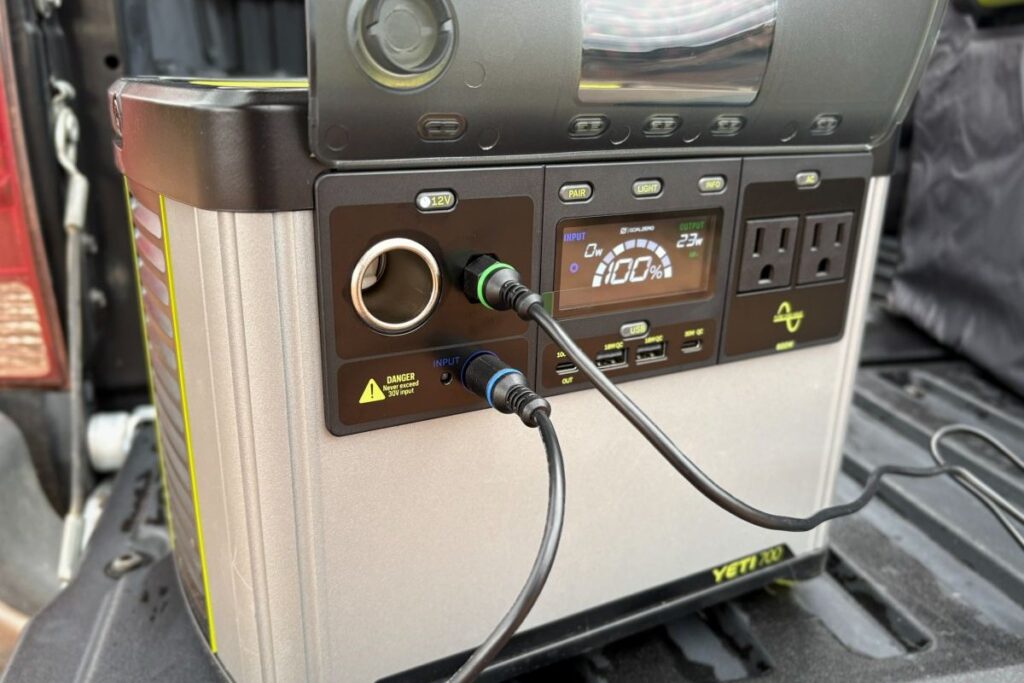
MSRP: $699.95 | Dimensions: 11.32 x 7.84 x 8.55 inches | Weight: 20.3 pounds
The Yeti 700 feels solid in hand, and its water resistance is reassuring around camp. It stores 677 watt-hours in a lithium iron phosphate (LiFePO4) battery that Goal Zero rates for 4,000 cycles to 80% of original capacity, or more than 10 years of daily use. It has an easy-carry handle and the outlets and digital readout are covered with dust and water-resistant rubber flaps.
Yeti power stations cost more than much of the competition, and durability is the main reason. Goal Zero says the Yeti series is the only power station line in its class with all of the following: a rugged aluminum enclosure, IPX4 weather resistance against rain and splashes, sealed port covers to block dust and debris, drop testing from 4 feet and vibration testing for off-road transport. It charges in temperatures from 32 to 104 degrees Fahrenheit and discharges from -4 to 104 degrees.
Output covers most camp needs. The pure sine wave AC inverter delivers 600 watts continuous with a 1,000-watt surge to two standard 115 volt 5 amp outlets, which Goal Zero says is enough for small power tools or a pellet grill. I was able to run a small Nuwave induction cooktop at the low-medium settings (enough to cook eggs) or a small instant hot water kettle for making coffee. There are also two 18-watt USB-A ports, a 100-watt USB-C PD port, two 30-watt USB-C ports, a 162-watt 12-volt car-style outlet and a 135-watt 6 mm port that powers the Alta fridge. Every port is clearly labeled. Upgrading to the Yeti 1500 would open up more options for running induction cooktops or even a small microwave.
The on-unit display shows input watts, output watts, hours remaining at the current draw and charge percentage. For anything beyond a quick glance, I recommend downloading the Goal Zero Power app and pairing it with the Yeti and Alta. The app is more intuitive than the small screen and adds controls the unit lacks, including power flow tracking and adjustable charge modes.
Charging options are flexible. On fast mode, the Yeti refills from a wall outlet in about 1.7 hours at 500 watts. It ships in a 340-watt default mode that takes about three hours but extends battery life and keeps the fan quieter. With Goal Zero’s $24.95 car charging cable, a 12-volt outlet recharges it in about six hours. Solar input tops out at 200 watts, which refills the battery in about four hours, while my Nomad 100 took about eight hours depending on sun exposure. The Yeti carries a five-year warranty.
Alta 50 electric cooler
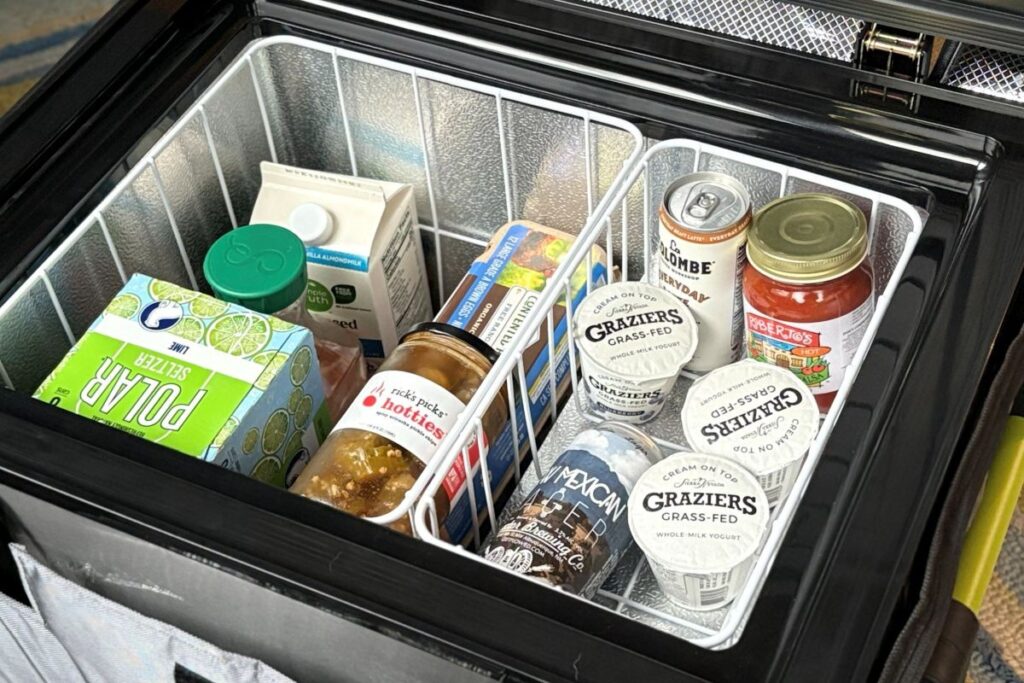
MSRP: $799.95 | Dimensions: 27.44 x 20.87 x 18.19 inches | Weight: 49.4 pounds
The first thing to know about the Alta 50 is that it works as a fridge or a freezer but not both at once, because it has a single compartment. You lose a dedicated freezer section, and in return the compartment is large for the size of the unit, holding 52.6 liters or about 75 12-ounce cans. Temperatures can be set anywhere from -4 to 68 degrees Fahrenheit.
Goal Zero’s Alta 80 offers dedicated fridge and freezer compartments, but it’s considerably larger and draws more power. Paired with the compact Yeti 700, the Alta 50 was the better fit for me. I only used it as a fridge and never needed a freezer.
The build quality is excellent. An LG compressor does the cooling with R600a refrigerant, and Goal Zero claims the Alta line is 25% more efficient per liter than leading competitors, averaging about 8 watts at 35 degrees. The stainless steel exterior comes with a cover that guards against dents and dings, adds insulation and has pockets for cords and accessories. Inside, two removable baskets divide the compartment, so you can find what you’re after even when it’s at the bottom. There’s also an interior LED light and a drain hole for cleaning.
The Alta 50 is heavy. When it’s full of food, moving it is a two-person job. Heavy-duty handles help, but there are no wheels.
A digital readout shows temperature and mode, and a touch pad adjusts the setting. The cooler also pairs with the app over Bluetooth, which is handy when it’s buried under gear in the back of the car. Goal Zero says it cools from 75 to 35 degrees in about 30 minutes. Like a home refrigerator, it holds temperature best when it’s full, and in my testing it stayed within 2 to 3 degrees of its setting. The Alta 50 has a two-year warranty.
Nomad 100 solar panel
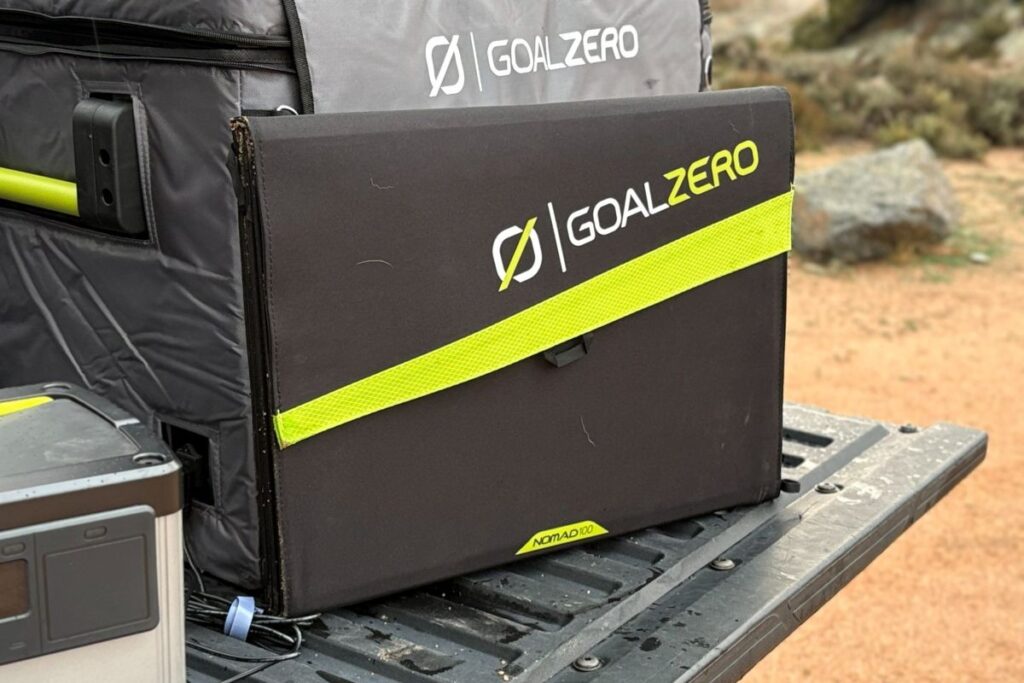
MSRP: $399.95 | Dimensions: 20.5 x 15.5 x 2 inches folded, 20.5 x 59.5 x 1 inches unfolded | Weight: 10.2 pounds
The Nomad 100 folds into a compact package held shut with magnets, and it unfolds in seconds. Cords store in a zippered pouch, built-in kickstands angle it toward the sun and the whole panel feels durable.
The monocrystalline panel is rated at 100 watts, and an integrated 6-foot cable with an 8 mm plug goes straight into the Yeti’s solar input. With good sun exposure, I typically saw about 85-90 watts going into the Yeti 700 from the solar panel, close to the panel’s rating. Goal Zero calls the Nomad weatherproof but notes that the fabric enclosure will wear faster if the panel lives outside full time. It has a two-year warranty.
How it all works as a system
The biggest question for me was how long I could realistically run the Alta 50 off the Yeti 700 and Nomad 100 on a longer trip without running out of power. The answer depends on a lot of variables, and weather is the biggest one. In hot weather the compressor runs more and draws more power, but you can probably depend on clear sunny days. On cloudy days it will require less power but the solar panel can’t do much to recharge the battery.
In typical Colorado mountain conditions during summer, with daytime highs around 75 degrees, nighttime lows around 50 and mostly sunny skies, I could run the system indefinitely. Overnight the cooler ran just enough to hold 38 degrees and pulled the Yeti down about 15% over 10 hours. During the day the Nomad 100 easily outpaced the draw from the fridge, putting in about 85-90 watts while the Alta 50 compressor drew about 35 watts when running (averaging 8 watts throughout the day). The Alta 50 is well insulated so the compressor didn’t need to work full time. At that rate the Nomad 100 panel recharged the Yeti within a few hours and kept it at 100 percent until sunset. As long as you get about four hours of direct sunshine per day, the system can keep running day after day without draining the Yeti 700 below 70% at any given time.
Goal Zero says a fully charged Yeti 700 can run the Alta 50 for more than three days with no solar input, which lines up with my numbers. Three straight days of heavy clouds is where you’d risk running out of juice. If your trip includes some driving each day, the Yeti recharges from a 12-volt car outlet or a wall outlet if you can find one.
Upgrades also reduce the risk. Goal Zero’s Nomad 200 solar panel would charge the Yeti 700 in about half the time, which would help on days with only partial sun, though it requires a $14.95 High Power Port-to-8 mm connector. If you want more storage, the larger Yeti 1500 power station more than doubles the capacity at 1,505 watt-hours.
The system isn’t cheap but it’s a good value considering you can use the power station for more than just running the cooler. At MSRP, the three components total $1,899.85 but you can save $149.95 buying it as a bundle. After eight weeks of using it, I found it a worthy investment.
The biggest difference from an ice cooler is everything you stop dealing with. There’s no ice to buy, no meltwater to drain and no fishing soggy food out of the water that inevitably pools at the bottom. The Alta holds the temperature you set rather than slowly warming as the ice melts, and it can run as a freezer when you need one. It’s cleaner and more reliable than a cooler. Ice eventually melts, while in average conditions the Goal Zero system stays charged and keeps running indefinitely.
The system is also easy to set up and easy to use, and the quality of all three components impressed me. If you set up base camp from the car often or just want cold drinks reliably waiting at the end of a long day’s adventure, it’s worth the investment.
Pros
• No more melted ice or waterlogged food
• Easy to setup and use as a complete system, with no engineering degree required
• Large compartment for the fridge unit’s overall size
• Solid build quality across all three components
Cons
• Expensive, even compared with a high-end cooler
• The Alta 50 can be a fridge or freezer but not both at the same time (upgrade to the Alta 80 if you want both).
• The Alta 50 is heavy when full and has no wheels.
Brian Riepe is the founder and publisher of Mountain Flyer magazine, Alpinist’s sister mountain bike publication. Brian was a climber and outdoor adventurer long before he discovered mountain bikes and has spent thousands of hours climbing, backpacking and trekking in both hemispheres.