
[This story originally appeared in Alpinist 91 (Autumn 2025), which is now available on newsstands and in our online store. Only a small fraction of our many long-form stories from the print edition are ever uploaded to Alpinist.com. Be sure to pick up the hard copies of Alpinist for all the goodness!–Ed.]
Indifference, ignorance, and impotence are socially produced: we can learn to not care, to turn away … to feel powerless in face of overwhelming force or impossible constraints … [to] feel alright about what we are doing or failing to do.—Mary Fulbrook, Bystander Society
How do you talk about Leni Riefenstahl without discussing Hitler?… You start with the image of a young woman. As the fog clears, her figure appears sitting barefoot on a rock on the top of a ragged mountain peak.—Riley Folsom, “In the Land of Gods and Monsters”
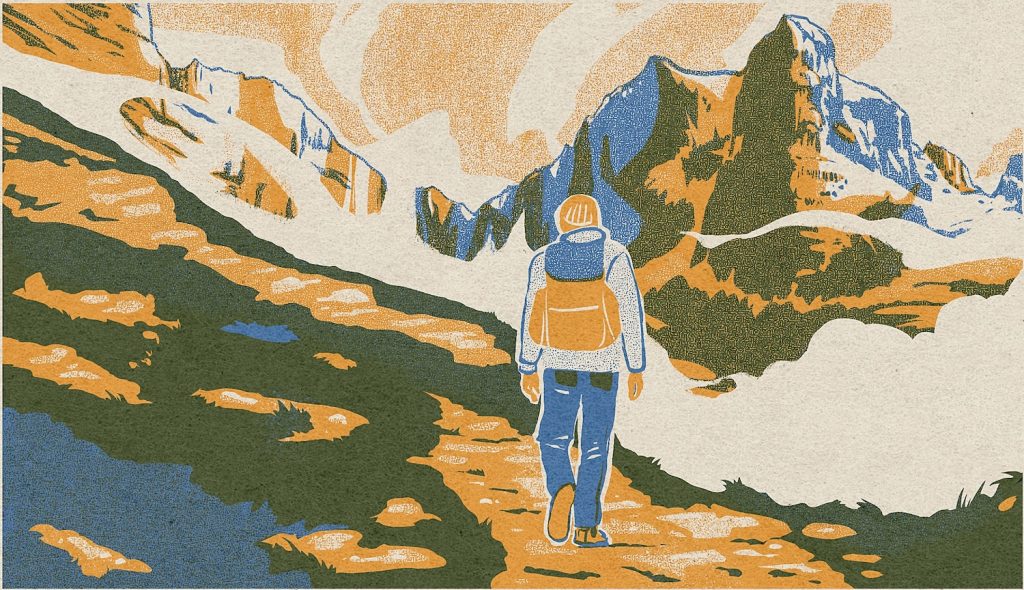
I AWAKE IN a parking lot in Madonna di Campiglio. Half crooked, in the passenger seat of my breath-fogged rental, I get moving, sluggishly. I turn the car key and crack the window, a barrier to the dawn air. September’s here and there’s a chill to match the moisture on the windshield. Let’s go climbing.
I unbag myself, slide laterally over the gearbox, reverse the car, drive some, park again, then, rucksack shouldered at the trailhead, I disappear up the forested switchbacks. Two ropes, a rack and a four-hour approach to the rifugio. Alone, in nature and with my own thoughts.
With elevation, the beech trees turn to larch—the canopy, thinning. Slowly, like a theater curtain retracting at one-eighth speed, the forest gives way to open air. An idyllic panorama inserts itself into my peripherals. Spires erupt from grassy hills. Mist-wrapped dolomite. It rained yesterday and that story spills from the cliffs. A lingering drizzle emphasizes the green. The trail narrows to a rocky ledge hemming the base of a buttress. Draped across my rain jacket, the hairs of my rope feel a little heavy now. When an arête is turned, the sun’s welcome return scene-sets my arrival.
The Brenta Valley. I consider the skyline, recollecting the peak names from the guidebook. Punte di Campiglio, beside and behind me. Cima Tosa, across the valley. Cima Margherita, a little farther still. Storied summits. And, of course, my object. Campanile Basso—“the low belltower”—up there on the left somewhere, among a jumble of not-yet-distinguishable neighbors.
Campanile Basso brims with interesting history. In the late nineteenth century, the Brenta group was a dynamo for competing nationalisms as German- and Italian-speaking alpinists vied for first ascents. The rivalry was not necessarily good-natured. A sign of territorially possessed times, interethnic animosities were often anchored in disputes about the building of incrementally higher huts, as though shelter-construction constituted an annexation claim.
At the heart of the competition, the striking “Belltower” was the ultimate prize. By 1897, an Italian team had come closest to the summit, leaving a wine bottle and a well-wisher’s note—written only in Italian—for the party that managed to finish it off. Then, in 1899, Otto Ampferer, the Austrian geologist who would go on to conceive the theory of continental drift, hiked up with Karl Berger. Much to the chagrin of the Italians, they ended up on top.
Others came later, writing new lines up Campanile Basso’s remaining flanks—King Albert I of Belgium (the so-called Roi Alpiniste) among them. Most hallowed of these climbs was Paul Preuss’s 1911 free-solo first ascent of the east face—a perspective-altering feat.
As David Smart narrates in his biography of Preuss:
The climb pitted Paul’s skill and bravery against his mortality, the fragility of his mind … and his image of himself as the climber and man who could do this incomparable thing.… Eighty of the best climbers in Europe had written their names in the summit register of Campanile Basso … none had recorded an effort as proud as Paul’s.
An equal or harder route would not be put up on the Belltower for two decades.
Meandering toward the hut, I mull the history. A history to consider cautiously.
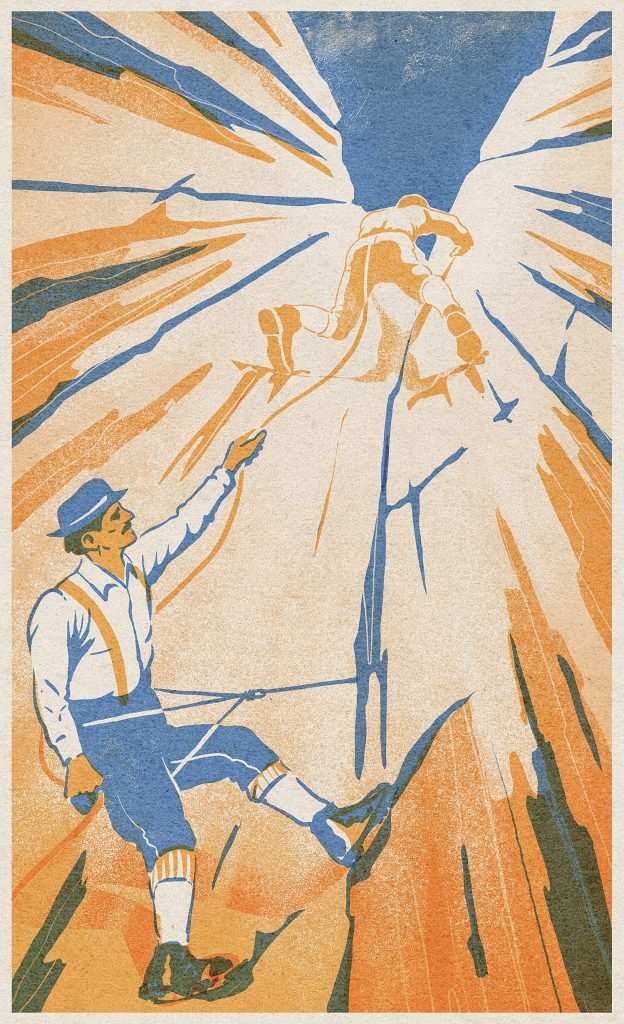
In 1937, while training for his first ascent of the North Face of the Eiger, Anderl Heckmair climbed Campanile Basso with Leni Riefenstahl, the celebrated actress and Nazi propagandist. Riefenstahl was famously mountain obsessed. Inspired to the heights after seeing Arnold Fanck’s Mountain of Destiny (1924), within the decade she had starred in back-to-back Fanck films, anchoring herself to the center of the genre. In 1929 she starred in Fanck’s The White Hell of Pitz Palu, which chronicles a German climber’s melancholic search for meaning after his bride (played by Riefenstahl) perishes in the Bernina Alps. In 1930, she reprised a derivative role, in Storm over Mont Blanc. By 1932, Riefenstahl had seized the reins herself, as the director of The Blue Light, a mountain fairy tale. The Brenta Valley features in this film. As Heckmair remarks in his account of their Campanile Basso ascent, portions of The Blue Light were shot on the very trail I had just walked.
As Riefenstahl’s fame grew, her actress-mountaineer celebrity put her in the Nazis’ orbit. Their predilections, naturally, were for people and things that dominated. The contours of her transition to propagandist were complicated, she always claimed, not particularly credibly. But the particulars of the transition were nevertheless curious. While Hitler seized the Reich Chancellery and set to the task of murdering his opponents, Riefenstahl’s next mountain film could well have been resistance art had she internalized its meaning. In Lowlands, a celebrated folk opera that Riefenstahl began adapting for screen in 1934, the audience follows the story of Pedro, a mountain shepherd, and Martha, a beggar-dancer, as they attempt to escape the clutches of a tyrannical landowner who has seized control of all the water down valley.
Midway through the adaptation process, distracted, apparently, by Hitler’s burgeoning personality cult, Riefenstahl parked the project and filmed Triumph of the Will (1935) instead. To some, the shift from mountain cinema to “the most successfully, most purely propagandistic film ever made” might seem quite the about-turn, but as the writer Susan Sontag remarks in her scathing 1975 review of Riefenstahl’s beauty-obsessed aesthetic, Triumph was merely the culmination of the director’s evident interest in the visual appeal of soldiering.
When I arrive at the Rifugio Brentei, the afternoon is still young. But I’m ready for warmth, dryness and comfort. Legs worked, I leave my pack at the hearth and go looking for the warden.
Some of these doorway stones look original, I think to myself. Climbers in 1935 must have seen these too.
IN THE MORNING, after breakfast, I set out for the Via Normale—the “normal” path to Campanile Basso’s summit. The weather is not looking optimal but I’m willing to see how it goes. At the very least I can figure out where the route starts. Fifteen minutes on, Campanile Basso reveals itself in full, perfect in its precipitousness. I continue up valley, contentedly alone. Moving toward a cranny on the spire’s south side, I pick away at the talus slowly. The usual boulderfield unpleasantries.
An hour later, and I’ve scoped the route from the front side. The line, honestly, is a traversing jumble. It might be the “normal” path, but it is not necessarily the ideal path. I resolve on a better-looking alternative. Although harder, the Fehrmann Dihedral, on Campanile Basso’s southwest side, is a more direct, more straightforward rope solo. Tracing the spire base around to the Fehrmann, I tie in for the first pitch. Grey clouds gather over the Cima Tosa. There’s that forecasted weather.
Two ropelengths later and the bad weather is settling in for good. Judging by the color change on the rock walls across from me, what’s drizzle now will be lashing rain momentarily. Time to fix, rap and head down for pasta. Better weather tomorrow.
Milking one-bar Wi-Fi back at the hut, I read up on the Fehrmann Dihedral’s first ascent. In 1908, Rudolf Fehrmann, a lawyer from Dresden, had come up here with an American, Oliver Perry-Smith. Fehrmann was an archetypal visionary of the period. With big ideas and big ethics, he was a core figure in the Elbe Mountains climbing scene. An advocate of minimalism, he’d proposed rope-soled shoes and sparing use of ironmongery to avoid damaging the brittle sandstone. A classically familiar climber-environmentalist. Perry-Smith was the irrepressible talent, famous for his first ascent of the Teufelsturm (German for “Devil’s Tower”)—then considered the most difficult climb in Saxon Switzerland.
The pair had a blazing season in the summer of 1908. After a first ascent in the Rosengarten group and an attempt at the north face of the Cima Piccola—during which Fehrmann was “twice struck by lightning”—they marched into the Brenta to try their luck on Campanile Basso. Seemingly without issue, they succeeded, establishing a benchmark near-direttissima on what is perhaps the spire’s most striking feature. Perry-Smith led everything, but Fehrmann, by chance or intention, signed the summit register first, printing his name, first and foremost, in the route’s history.
In his post-Campanile years, Fehrmann disappeared from notoriety, until, in 1932, he resurfaced as a newly carded member of the Nazi Party, mere months before Germany’s last free and fair elections of the Weimar era. Now a Doctor of Laws, Fehrmann donned robes as a military judge during World War II, until, upon capture by Soviet forces, he died an accused war criminal in the “special camps” of the NKVD.
Dark history, I muse, watching dusk grip the Brenta group through the hut window. The rain is falling in streams now. I figure that every climber has their own motivations for seeking out mountains. Fehrmann’s, presumably, were a product of his time. Still, I have to wonder: What happened to Fehrmann the climber? Did he forget about those (apparently strict) ethics? Did he off-load the unmissable lessons of being in the mountains? Did he forget about the companionship? About humanity? And what happened to his relationship with Perry-Smith? Did they stay in contact after Perry-Smith left for America in September 1914? Years later, when the Second World War broke out, did they communicate, transatlantically, on opposite sides of right and wrong? Hard to know.
I repack my ruck and slink off to bed.
MORNING COMES WITH clearer skies and a better forecast. An hour later, I am en route again. Three pitches up a crack-riven corner, I reach the base of an interesting chimney feature. It is still wet from yesterday, but here and there, ancient pins tack archaeologic proof of human passage. The route continues—three-dimensional climbing on bucket holds with good protection. Leading, fixing, back cleaning and re-climbing, I move efficiently, enjoying the opportunity to second what I have already climbed. Twice the feast.
From a belay anchor on a farther-up stance, I punch toward a sulfur-colored rooflet. Chossier handholds now. Reaching high left from a locked-off right arm, I pull a large hold off the wall. The rock asteroids into the belay stance below me, exploding everywhere. It occurs to me that the plucked hold could well have killed my belayer were I not rope-soloing. I look up again, keen to be through this bodylength. Pinching a fixed pin to my right, I aid-scratch through the remaining litter.
Above, the climbing improves, in steepness and in quality. The long corner—two pitches of stemming and liebacking. Not unpleasantly, 300 meters of exposure paws at my legs and harness. Just the exit pitches now.
It is two o’clock and the clouds over the Cima Tosa gather again. Just like yesterday, before it rained. Hmmm …
Just the grey slabs to the shoulder to go. To the junction with the Via Normale. The slabs prove a route-finding quandary. I take my time with them. As I smear through the final crux, the first raindrops hit the rock. Damn. Manteling onto the Belltower’s shoulder, I’ve reached the Stradone Provinciale (the “provincial road”)—the giant ledge that wraps Campanile Basso’s upper belfry. Fehrmann’s route is dispensed with and below me now. In theory, the summit should be easily reachable from here.
Lightning hits the Cima Tosa.
Feeling short on time, I coil the rope into a bag and begin free soloing. Fourth- and low-fifth-class terrain. The drizzle becomes colder as I ascend, approaching freezing temps. Small patches of slush now, congregating on the handholds. Consistent with the route description, a chimney appears. I slither into the breach to take stock.
Options …
It is not merely raining now. It is hailing. Summit registry probabilities are dwindling. Moving noncommittally, I exit the chimney into openness, then re-rope. The exit face is completely running water. Another peal of thunder. Hailing hard.
Grim.
From the top, a pitch and a half above me, two rope ends come tumbling down. A pair of French climbers are rappelling from the summit.
Calling it.
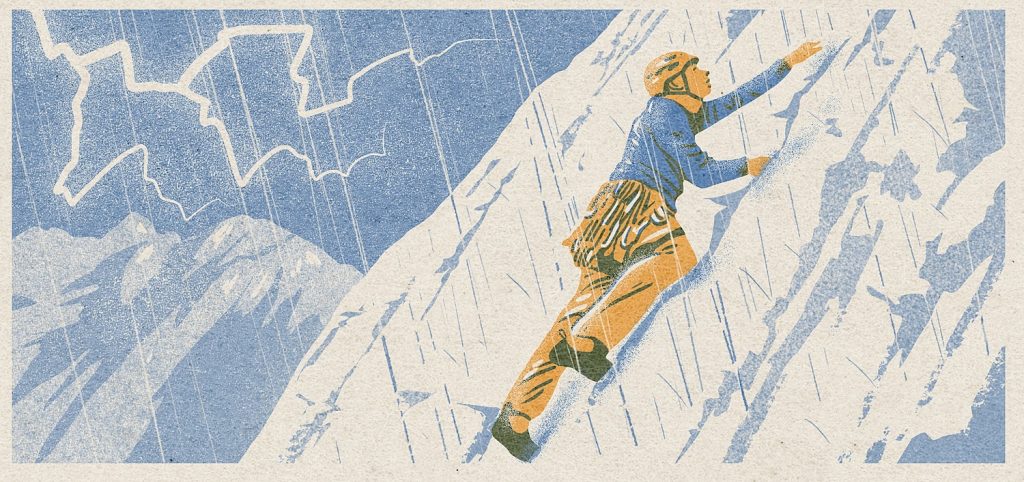
I rap back to the Stradone Provinciale, burrowing under a ledge to see if it’s worth waiting out the worsening weather. Fast becoming a tempest now. Annoyed at the overoptimistic forecast, my mind drifts to another Anderl-and-Leni anecdote. Heckmair and Riefenstahl were caught in a storm up here as well, forced to bivy. “I mustn’t catch cold, I’m not well,” Riefenstahl had complained. As Heckmair relays: “The rest of her words were drowned in a terrifying crash of thunder. Hail poured over us, while the lightning flashed and glimmered incessantly in the black cloud.”
I descend with the French guys, chatting and joking on the rappels. Arriving at the rifugio, well past ten at night, I collapse into my bunk. Beat. Satisfied.
Morning comes. I have obligations now, down valley. My parents are waiting for me in Florence. As I trot off downhill, my mind again flits to Heckmair. When I read the account of his ascent, it was difficult to know what he had learned from the experience. Coming off the mountain, he and Riefenstahl had driven together to a hotel in Bolzano. There, Heckmair recounts, Leni’s high-level contacts brought him an audience with the führer himself. Not unlike Riefenstahl, Hitler was a man enthralled with mountains. In his younger days, he expressed this interest often, in his paintings. His 1926 work Alpenhof—meaning “court of the mountains”—depicts a scene not dissimilar to the one through which I am now descending.
Accordingly, the broader activity of mountaineering—or at least the valley-conceived idea of it—came to occupy a special place of significance in Nazi sitting rooms. For the Reich elite, it testified to the conquest of Nature by “Aryan Man”—a sporting extension of the geographic inevitability of the German war machine. Heckmair’s recollections support this.
“The questions he put to me were very much to the point,” he writes of his encounter with Hitler. “He bored his way relentlessly into every aspect of the subject [of mountaineering]. In all this my own person interested him not a straw. It was the phenomenon that absorbed him.”
With Heckmair reduced to an object that simply did things, Hitler’s interest in Heckmair’s climbing extended only to the activity’s mechanics. There was no “who” worth grasping—only a “what” and a “how.” The fascist ordering of the world—where function is what matters and ancillary forms are expunged. The rank absurdity of Hitler’s politics—the depersonalized ideology sweeping the lowlands—was not lost on Heckmair, the mountain guide.
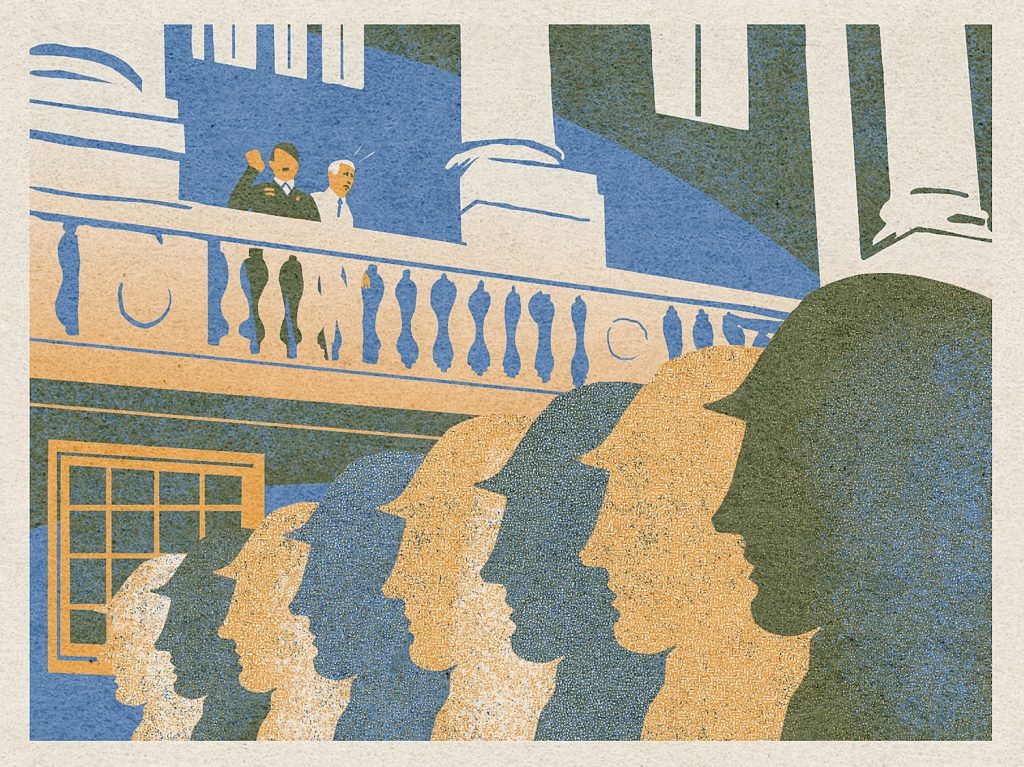
In the meeting’s climax, Heckmair recounts accompanying the führer onto the hotel balcony during an SS march-past. There, Heckmair raised his right hand, performing the infamous salute—his first foray into the aesthetics of Nazism. As he writes:
My situation as an anonymous, unpolitical, or unbelieving climber standing beside the fanatically acclaimed leader struck me as so grotesque.… As the umpteenth thousand marcher paraded past us yelling, I thought of the loneliness of the mountains and of the hordes of humanity below. Naturally I came to no conclusion; I simply found the whole thing remarkable, disturbing, somehow inexplicable.
When I read this for the first time, it was this final juxtaposition—the distinction between the freedom of the hills and the spiraling industrial politics of the lowlands—that most interested me. Even then, in 1937, Heckmair realized something was wrong: “I understood that something was in motion that was going to sweep everything away with it, but where to I could not tell.”
What, then, was the responsibility of the alpinist when faced with these political developments?
Though the specifics of Europe’s future were admittedly unknowable, the conclusion he should have arrived at seems obvious now. There was a lesson to be learned from his climb with Riefenstahl—one that wasn’t necessarily acquired by signing the summit register.
In old-world Italy, the rugged vias wending their way through these mountains were once rife with banditi—brigands, outlaws and “social bandits” thriving in the unsettled margins beyond the reach of the state. That lifestyle—freewheeling, politically unattached, but fundamentally libertarian—was the aesthetic that Heckmair was trying to summon while standing next to Hitler on the balcony, what he later describes as his own “unbelieving.” If his life—the life of a mountaineer—was a life spent looking for freedom, what need was there to preoccupy himself with the politics of the plains? It is a familiar attitude—one I’ve often interiorized.
Evidently, though, there are limits to this logic. Over the centuries, the beating-in of trails, the stocking of rifugi, the stapling of via ferrata and, eventually, the passage of armies had taken steps to civilize this ruggedness—to connect the mountains with the plains. Extensors of Man and State had brought industry even into these high places. It was this aesthetic—the aesthetic of conquest—that the Nazis admired in mountaineering. Climbing as a human-laid foundation for stone causeways and iron railways. The mountaineer as the mechanistic instrument of a nihilistic progress. The word “fascism,” after all, derived from the Italian fascio—“bundle of rods.”
What, then, was the responsibility of the alpinist when faced with these political developments? Was it to remain “anonymous,” à la Heckmair? To turn away from the valleys altogether? To ignore the facts in the lowlands and disappear into the landscape?
In Bystander Society, a study of the German people’s incrementally complicit descent into fascism, the historian Mary Fulbrook describes how the surrounding Alps represented a kind of political duality for those holidaying in them. On the one hand, mountains were a place where victims could find asylum from the horrors of the lowlands. Up there, in the fresh mountain air, even Jews could “breathe more freely.” On the other hand, this freedom was not unlimited. Some transformations taking place in society proved impossible to escape. Fulbrook recounts one half-Jewish couple’s sojourn in the Swiss Alps:
Even here … the echoes of Nazism reverberated. Two tourists from Berlin turned up at the mountain hut where they were staying, and when [they] saw the name “Dreyfuss” in the visitors’ book they proceeded to attempt to persuade the surprised chalet owner of the virtues of Nazism.
This inescapable fact—the fact of Nazism’s inescapability—forced everyone to make a choice. To do nothing, or to do something. Heckmair’s attempt to remain “anonymous,” then, was difficult to justify—built as it was on a fictional isolation. It also seems to me that Heckmair’s pursuit of wilderness solitude was only valuable if it led the way-seeker back to society—back to fulfilling some bigger set of responsibilities.
Ironically, Fehrmann seemed to understand that a mountain journey was, and could only ever be, a transient experience—a moment in life that merely precedes other moments. A busy office professional with a life, as he put it, in “the torment and restlessness of the big city,” Fehrmann understood that the “refuge” of the mountains was necessarily temporary. He also understood the concept of having responsibilities. What he had catastrophically failed to grasp was the nature of those responsibilities—especially where they pertained to fundamental moral questions.
The history of alpinism in the Brenta Dolomites is a dramatis personae of characters who “achieved” things that are very comprehensible to me as a climber. But some of these characters also lacked the will and insight to see and do the right thing when it mattered most.
When in August 1934, Hinterhermsdorf Forest district authorities began arresting hikers for walking along backcountry roads at night, Fehrmann wrote a scathing criticism of this “arbitrary” practice. The forest officials were applying the law against straying from “paths designated for public use” in an overly restrictive way, he claimed, contradicting the spirit and letter of the Nazi motto Strength Through Joy. These same officials were also ignoring what Fehrmann considered climbing’s proper social function—to strengthen the German people’s body and spirit and to enable their return to daily work “more than ever connected to our homeland and fatherland.” In other words, mountaineering as physical training for a fascist destiny.
Like Fehrmann, Riefenstahl had also misunderstood the nature of her responsibilities—or, perhaps more likely, simply discarded them in pursuit of her own visions of “triumph” and “beauty.” When she finally got around to filming Lowlands in 1940, she employed forced labor on set—Roma and Sinti actors impressed into cinematic servitude. Later, some of these laborers were sent off to Auschwitz.
How, then, am I to unify mountain escapism with my own obligations—my social responsibilities—to the plains?
Reaching the car, I grapple with the question. What is the lesson here? The history of alpinism in the Brenta Dolomites is a dramatis personae of characters who “achieved” things that are very comprehensible to me as a climber. But some of these characters also lacked the will and insight to see and do the right thing when it mattered most. In other words, it was possible to both brave the odds and “triumph” and be a coward at the same time.
Faced with the facts of the Third Reich—faced with the huffing-red face of ultraviolent racism—three alpinists had chosen different variations of the same via normale. The “normal path” Heckmair chose was a path to ignore. Fehrmann’s path was a path to join. Riefenstahl’s path was a path to promote. All three paths led to complicity—a destination they all shared in common. How did they get there? These were, ostensibly, courageous people—people who were willing to sit out storms and tickle the abyss, for fun. So where had that courage gone? Wouldn’t I have done differently?
Had I been on that balcony with Hitler beside me and a mass of marching troops below, what would I have done? My moral responsibility, I suppose, was to not be there in the first place. To refuse fascism’s gravitational pull. To resist it openly if necessary. Then there was the responsibility to recognize the harm being caused to others, and to help these harmed others find refuge—in the mountains perhaps. At a bare fucking minimum, my responsibility—as an alpinist, as a human—was to not go out on the balcony and blast the fucking Hitler salute.
[This story originally appeared in Alpinist 91 (Autumn 2025), which is now available on newsstands and in our online store. Only a small fraction of our many long-form stories from the print edition are ever uploaded to Alpinist.com. Be sure to pick up the hard copies of Alpinist for all the goodness!–Ed.]