

[This Sharp End story originally appeared in Alpinist 94 (Summer 2026), which is now available on newsstands and in our online store. Only a small fraction of our many long-form stories from the print edition are ever uploaded to Alpinist.com. Be sure to pick up the hard copies of Alpinist for all the goodness!–Ed.]
WHEN I CAME OF age in the late 1990s and 2000s, Dean Potter embodied what it meant to be a climber: a free spirit who saw beyond any perceived limitations; someone who channeled the wildness in his heart and pushed himself to the edge of his abilities, fully committed with everything at stake. He was in all the climbing media, all the ads. A rock star. For many of us, he defined the fashion and the attitude as well as the vision.
A four-part documentary about Potter’s life, titled The Dark Wizard, was released on HBO Max in April. It provides a retrospective on his life and influence, and an occasion to consider a culture that celebrates risk-taking and rebellious, free-spirited characters.
Potter rose to fame through what he called his “dark arts”—namely free soloing, highlining and BASE jumping. To put that in layman’s terms: climbing and highlining without a rope and parachuting off cliffs. All of which led him to become a practitioner of wingsuit flying and a progenitor of FreeBASE climbing (free solo climbing with a parachute on his back). In 2015 Potter died in a wingsuit BASE jumping accident in Yosemite Valley along with his twenty-nine-year-old companion, Graham Hunt. Potter was forty-three, the same age I am now.
I was sixteen in 1999 when photos appeared in the climbing mags of him free soloing on Half Dome and El Capitan, carrying a small coil of rope on his back and a handful of gear that he used to protect a few short sections. By then I’d only been rock climbing for a about five years, but I’d already been fantasizing of what it would be like to dangle from the side of a massive wall, engulfed in air. The photos reinforced the notion that climbing was about performing in the face of mortal danger. A vision quest of sorts.
In the first episode of The Dark Wizard, Eric Perlman, who filmed Potter for his 2001 film Masters of Stone V, reflects: “There is something intrinsically beautiful when life is on the line. In the crucible of adventure sport, the spirit of man rises to a whole new level. That’s what evolution demands of us.”
Conversely, another climbing luminary privately shared with me that “the need to use danger as a means to ‘enrich the soul’ actually reflects emotional scarcity, not depth.”
In the end, Potter’s desire to keep up with Hunt’s ability led to his fatal wingsuit crash, in which Hunt died alongside him.
IT’S WORTH STEPPING BACK to observe that the 1990s and 2000s are now widely considered to be a peak era for “toxic masculinity” in American media. Men were depicted as tough and unafraid, always getting what they wanted. Mountain Dew commercials featuring extreme sports were trending. (These days it’s Red Bull.) And Alpinist 0 was published in 2002, a niche publication dominated by white males, with gritty narratives about pushing the limits of alpine style. Potter’s own writing and photos appear throughout the archive.
Based on what is shared in The Dark Wizard, including pages from Potter’s journals and behind-the-scenes footage, he was a man of his time. At six feet five, he was large and muscular, and he challenged authority often. By all accounts he was an “alpha male.” In the film we see a man who can be gentle and poetic in one moment, then hostile and threatening the next. We see him alienate his wife, Steph Davis, and many of his closest friends as he loses control of his ego and takes ever-greater risks.
The appearance of Alex Honnold as an up-and-comer with superior free soloing abilities destabilizes Potter’s self-image and inflames his competitive drive. Honnold acknowledges in the film that Potter had been an inspiration to him while he was growing up. After The Dark Wizard aired, Honnold wrote on Instagram on May 16: “I was always kind of afraid of him because he was so intense. But I’d always been super inspired by his climbing and his vision.” Nonetheless, Honnold was rebuffed from the outset.
Even Timmy O’Neill—who had been one of Potter’s original climbing partners and set two speed records with him on the Nose in 2001—was pushed away. “We did the raddest shit. And had the most fun.… But then, when I started to be recognized for my own climbing, I became competition,” O’Neill laments in episode three. “He did not know how to be gracious with another person’s light.”
The script of competitive jealousy replays later when Graham Hunt surpasses Potter’s ability in wingsuit flying. But by this time Potter is resettled with a new life partner in Jen Rapp, along with her children from a previous marriage, and he recognizes his negative feelings bubbling up toward his beloved protégé. In voice memos to himself he expresses worry that he could end up pushing Hunt away if he’s not careful. “He was mad at himself for feeling that way,” Rapp recounts in the series.
In the end, Potter’s desire to keep up with Hunt’s ability led to his fatal wingsuit crash, in which Hunt died alongside him. People worldwide were devastated, and in the film it’s clear that some of Potter’s estranged friends were left utterly heartbroken. He was a very flawed human who made terrible mistakes in the way he treated people. But he was, and still is, deeply loved.
Soon after learning of the accident, Katie Ives, then editor of Alpinist, wrote a remembrance of Potter, titled “Poet of Light and Air.” She reflected:
Dean and I worked together for years on various writing projects, for Alpinist and elsewhere. And as an editor, you get to glimpse something of your writers’ inmost selves—those fragments of dreams and hopes and fears stirred up by the creative process.…
… He hoped that by confronting his fears … he might find a way to turn the nightmare around, to transform a terror of falling into a dream of flying, to find some hidden key to change the impossible into reality, to go beyond the limits of the physical and still return safely home.…
During those days of my unemployment when he tried so hard to look after my well-being, I thought of him as an older brother.…
He lived his life like a poem.
“I want to be a part of what turns this world more soulful,” he wrote to me in October 2008.
I want to tell him that he was.
WHILE THERE MAY BE truth in the statement that seeking danger “reflects emotional scarcity, not depth,” we do well to remember that there are examples of risk-takers who challenge that notion.
Tommy Caldwell comes to mind. As one of the most well-rounded rock climbers of all time, he set the current speed record on the Nose with Honnold in 2018 when they blitzed the route in 1 hour, 58 minutes—a feat that required several laps on the route with no small amount of risk. That was just one of their exploits together. Over the last decade, Caldwell has become a political and environmental advocate while raising a family and continuing to climb at a high level in a variety of disciplines. Anyone who has met him or read his words is unlikely to accuse him of lacking emotional depth.
Guy Lacelle was another person of such character, from what I know. He was a legendary Canadian ice climber who often soloed huge, difficult routes in the mountains. He lived a quiet lifestyle and was committed to his loved ones, and as a passionate tree planter he made a career of giving back to the environment. He died in 2009 at age fifty-four, when a small avalanche caught him in a bottlenecked couloir while he was descending a route during the Bozeman Ice Festival. Bad luck.
In a 2008 Q&A with Alpinist, Lacelle was asked if soloing defined him as a climber. “I guess in a way it does,” he responded. “My best abilities are solicited when soloing. It is the activity that I am the most suited for physically and especially mentally.”
When asked about his scariest moment on a free solo climb, he said:
During the early 1990s I tried the first free solo ascent (as far as I know) of Nemesis. The climb was going to push me close to my limit.… On the steepest section of the climb the ice got very thin and brittle. I started getting stressed and tired. As my forearms got pumped, I didn’t feel my placements very well and broke a pick. When I swung the other tool harder, I bent that one. I was too pumped to pull my third tool, which was stuck in my [holster]. When I realized that a fall was imminent, I decided to keep climbing fairly quickly on marginal placements as a last alternative, and it worked. When I reached a rappel stance and contemplated if I should continue climbing using the third tool I realized that I had already failed whether I reached the top or not, and I came down. I waited almost ten years before returning for the solo. This time I was ready and was able to chase the demons that were still in my head.
Hmmm. Demons in the head. That does hint of darkness in the mind of a soloist yet again, doesn’t it?
Someone who says they aren’t contending with some sort of inner strife—doubts, worries, fears, addiction—is deluding themselves. It’s how we respond to such things that defines our character. Lacelle’s admission of “failure” to maintain a greater level of control indicates that he was aware he’d crossed a line and was lucky to get away with it. He learned and came back. Isn’t the main obligation we face in life to learn and grow?
Yet the question remains, what is it about extreme sports that holds some of us like moths to a flame?
My body simply urged to express itself in these ways; my heart looped and spun and climbed and dove, and I wanted to embody that.
I’VE BEEN ATTRACTED TO exposed, risky places for as long as I can remember, ever since I was only a few years old. My eyes have always been drawn to vectors where the earth meets the air, like the sharp outline of the Rocky Mountains on the horizon. I loved climbing as high as I could in our tree, feeling it sway under my weight as the limbs grew thinner. Sometimes I hung upside down with my legs hooked over a branch. I only fell once or twice—enough to learn to pay better attention. Eventually I learned to snowboard. I hungered for jumps and air time, sacrificing my body to learn tricks. All the while, tall rocks captivated my imagination more than anything else. These desires were intrinsic. My body simply urged to express itself in these ways; my heart looped and spun and climbed and dove, and I wanted to embody that.
One day, in my mid-twenties, I was alone on the rim of Yosemite overlooking Lost Arrow Spire, where I watched a group of ravens as they took turns hopping off the side of the cliff. A bird would drop out of view and then rise on an updraft. There, just a few feet away, they’d hover and perform barrel rolls and other maneuvers before landing back on the rim. A few of them gazed back at me while they did it, as if showing off. That was the beginning of my own obsession with the birds that had inspired Dean Potter.
Even now as I write this, I have a carved stone totem of a raven sitting near my keyboard, where it’s been for years. The totem was made by a Zuni artist in Sante Fe, New Mexico, who directed me to give it offerings of cornmeal with an intention or prayer in mind. The pamphlet that was handed to me reads: “Raven’s medicine is that of informing us of our inner, more hidden world to which we need to become comfortable in order to experience a change in consciousness. That shadow part of ourselves can be of great help to us if we have the courage to look into it. Raven is comfortable there and offers us the opportunity to discover personal fears and demons that are keeping us from our awakening and our magic.”
Those words could also describe what so many of us receive through “extreme” pursuits.
There are also other, less flashy ways to find portals to expanded consciousness. Hence the totem on my desk as I labor at the keyboard.
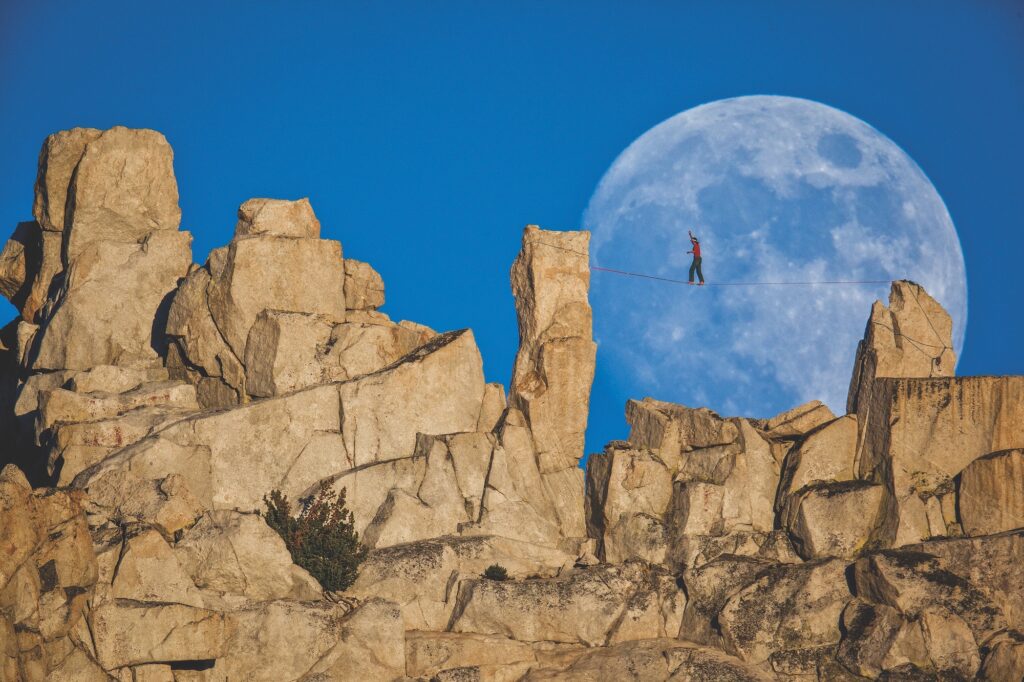
POTTER CONSIDERED HIMSELF a performance artist. There were times when his motivations appear to have been clouded by commercial incentives, but I agree that he was an artist. A prime example presented in the film is when he calculated the precise time of day that a full moon would pass between two pinnacles of rock, set a highline between them and walked across it for Mikey Schaefer’s camera.
Art directs the mind upward, expanding it. It enables us to see or feel parts of our human condition from the outside, like gazing out of an airplane window.
What is true art?
I would say it is a form of expression that affects our perception. Art directs the mind upward, expanding it. It enables us to see or feel parts of our human condition from the outside, like gazing out of an airplane window. It gives perspective. The work is likely the result of an artist who sought perspective through a long and winding process.
A climb can feel like a work of art, providing an aesthetic sense of flow through situations that inspire a range of emotions—fear, curiosity, doubt, relief, bliss, to name a few. The medium is primarily nature’s work, of course, but it also takes vision to establish a route: to identify how to piece together the natural features in the most rewarding way, with the best belay stances to break up the pitches, and establish just the right amount of fixed protection (or not) to the point that the line becomes an experience that people seek out.
At their best, such pursuits lead me to new ways of seeing things. At their worst they become a distraction, potentially an addiction. The same can be said of drugs and the internet, even books (rare, but I’ve seen it)—anything that allows us to avoid reality. Tools that can be used to enhance our awareness can also blind us. Whatever we pursue in life has the potential to drift into becoming a vice. Like walking a highline, balanced steps are really what the “process” is all about.
“My brother would say the key to happiness is following beauty and not the urge to be the best,” Potter’s sister Elizabeth says in the third episode. “In his most centered moments he knew it was all about listening to your heart and following that.”
“I want to be a part of what turns this world more soulful.”
–Dean Potter, 2008
TODAY, CLIMBING MEANS a lot of different things to a lot of different people. Rather than a mere handful of men and a few women defining the culture, we have a mix of bona fide pros representing every size, shape, color and gender in every climbing discipline, plus an endless stream of influencers.
One of the latest personalities to go viral is twenty-two-year-old Lincoln Knowles from Utah, who now identifies himself as a “Professional Free Soloist” on his @lincolnclimbs account. A couple of years ago online forums started lighting up with people denouncing what appeared to be a cocky young man proclaiming that he was going to free solo a new route every day until he fell. It turned out to be calculated “rage bait” to earn him attention, and within the last year it’s been revealed that Knowles is a savvy entrepreneur. Cedar Wright, one of Potter’s estranged friends, reached out to Knowles to see if he was legit. The answer was yes, and Knowles has since been interviewed by Honnold on the Climbing Gold podcast, as well as by other outlets.
In one such interview, with Chris Furey for Teton Gravity Research, Knowles says, “Recently, Dean Potter has been a big influence. I try to learn as much as I can from him; what to take forward and what to avoid. He’s complex, and I relate to that.”
For his part, Furey concludes that “beneath the noise of the internet persona, [Knowles’s] view of free soloing remains consistent: not performance for attention, but slow progression toward control, clarity, and capability in its most stripped-down form.”
Said “persona” includes smoking joints mid-solo on rocks and buildings, swigging gratuitously from bottles of vodka in a climbing gym and soloing an ice climb in Austria without a helmet. In a nihilistic way, Knowles satirizes climbing culture and social media handwringing while putting his life on the line. It’s hard to tell how much of the hyper-masculinity is performative—is he endorsing the machismo culture or making fun of it? Either way, the content is trending at a time when members of the Trump administration are propagating male strength and superiority with a strange aggression. I call Knowles’s success a sign of the times.
“Do whatever the f*ck you want; even if it seems crazy, and even if everyone tells you not to,” Knowles tells Furey when asked “what it’s all about” for him.
Me, I just want to be a part of what turns this world more soulful.