

[This Mountain Profile essay about the Tiedemann Group originally appeared in Alpinist 92, which is now available on newsstands and in our online store. You can read all five essays here. Only a small fraction of our many long-form stories from the print edition are ever uploaded to Alpinist.com. Be sure to pick up Alpinist 92 for all the goodness!–Ed.]
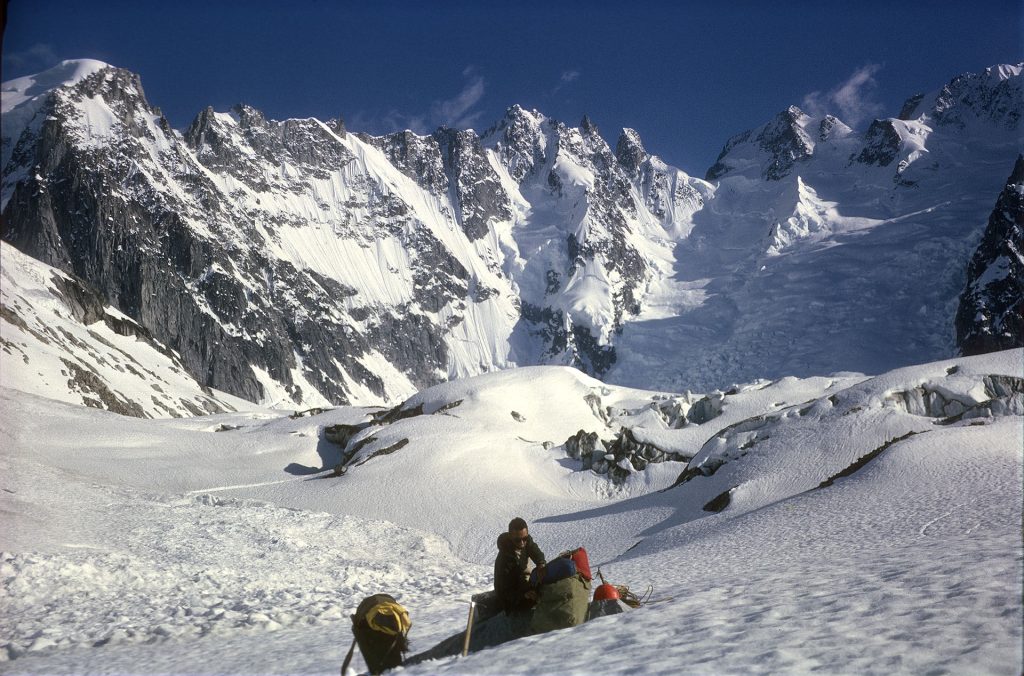
“DO YOU WANT TO DO the prospecting thing again next summer?” Dick Culbert was referring to 1962, when he and I and two others had received some money from the provincial government to look at areas of the Coast Mountains that were too rugged and difficult for most prospectors. It wasn’t a scam, just a sweet way to partly finance a long summer of exploratory mountaineering and peak bagging. To honor the terms of the grant, we had to prospect as we climbed; the two activities were not mutually exclusive.
Dick continued, “We never did get into the Waddington area, and Serra V needs climbing. If we don’t get it soon, Fred Beckey probably will.” That settled it. Late May found us leaving Vancouver in the “Tomato Soup Can,” our rotting VW van, purchased with some funds from our latest prospecting grant of $700 each. The van was stuffed with a couple of drums of aviation fuel and enough food and climbing gear to support the long summer we had planned.
After a week in the little-known mountains north of Bella Coola, we met our friend and fellow climber Roy Mason at Chilanko Lodge in the plateau country north of the Waddington Range. We were happy to unload the avgas, the weight of which was taxing our van. The plan was for Roy to fly us into the Scimitar Glacier in NZU, his Piper Super Cub plane on skis and wheels. We hoped to climb Serra V, backpack through lesser-known parts of the Waddington Range, head north and climb in what we named the Pantheon Range, and eventually hike out to our van in the Chilcotin, five to six weeks later.
During the next day or so of bad weather, we learned that Roy was also flying a strong party into the Rainy Knob area, a quartet of Canadians and Brits who hoped to climb the unclimbed northwest ridge of Mt. Waddington and Serra V. We knew these folks by reputation, but we had only climbed with one of them. They were certainly more confident than we were, and they said, “You guys are strong scramblers and hill walkers, but you are out of your depth in this range. Leave the real mountains to real mountaineers.” We didn’t say much; what was there to say? But inwardly, I felt that there was some truth to the banter. I was certain of Dick’s abilities, but I was uncertain as to mine. Years later I learned that Dick was uncertain about his abilities but had confidence in mine.
My diary for July 15 reads: “At last a day of decent weather. At 8 a.m. Roy flew me onto the Scimitar Glacier where it is joined by the Chaos Glacier. By 10 a.m. Dick had arrived and Roy took off to fly the other party.” We packed enough food for a week and cached the rest on a large boulder where it would be easy to find, even in fog. Then we packed down the Scimitar and up the lower Radiant Glacier to where we had a good view of the Serras, Asperity and Tiedemann.
We were appalled at how wintry and plastered with snow the peaks looked. Dick wrote in the 1965 Canadian Alpine Journal, “The records for rainfall and low average temperatures set by coastal weather in the summer of 1964 were suitably introduced by a wet spring and late runoff.” We were clearly at least two weeks too early for the big peaks. We had planned for an early season trip, mainly because we knew that, at 3590 meters, Serra V was the highest unclimbed peak in provincial Canada and we weren’t the only ones interested in it. But there we were, in mid-June, with nothing to do but make the best of it. We spent a couple of hours discussing a route for the next day’s attempt. In Vancouver, what photos we could find suggested that the best and safest route might be up and over Tiedemann and Asperity, but that would probably require a couple of nights out. With the abundant snow cover, the Radiant headwall looked feasible, and that was the route we chose.
We camped that night on the flat part of the Radiant at about 2100 meters, well away from any possible avalanches from the peaks above.
We were away at 5 a.m. There was no wind, no clouds or mist on the peaks or in the valley, and best of all, no high cirrus. We were cautiously optimistic: maybe we were in for an extended spell of good weather. The fresh snow on the lower part of the Radiant icefall was knee-deep slush, very tiring to plow through. Partway up the icefall, the snow conditions improved and we made better time. The huge ice walls above us and beneath the Asperity–Serra V col looked bigger and more unstable the higher we got. We could see the tent of the other party far below on the Tiedemann Glacier. We moved right, out of the line of fire from the ice cliffs, and climbed a couple of leads up hard, laminated ice in a gully to some rocks and a shaky belay. As was the norm throughout our climbing partnership, I usually led the ice and steep snow, while Dick took the steep rock. Both of us thought we got the better part of the bargain. After one more lead on ice, the angle eased back and we were at the col.
We didn’t have any time to rest, though, as a storm was rapidly moving in, and already it was snowing on Waddington and Mt. Munday. The summit tower consisted of superb rock, and the first two leads went well—but then the snow arrived. Writing in the University of British Columbia’s Varsity Outdoor Club Journal, Dick recalled, “Light slides of new snow hiss around us in the mists as [I lead] on up the face, using [my] crampons to bite through snow into the verglas beneath. Let us just say it was ‘hairy,’—perhaps more dangerous than difficult.”
When we reached the summit at 8 p.m., the blizzard was in full swing. “Chalk one up for the hill walkers,” Dick said as he wrote our names on the first page of the summit register and I set up the first rappel.
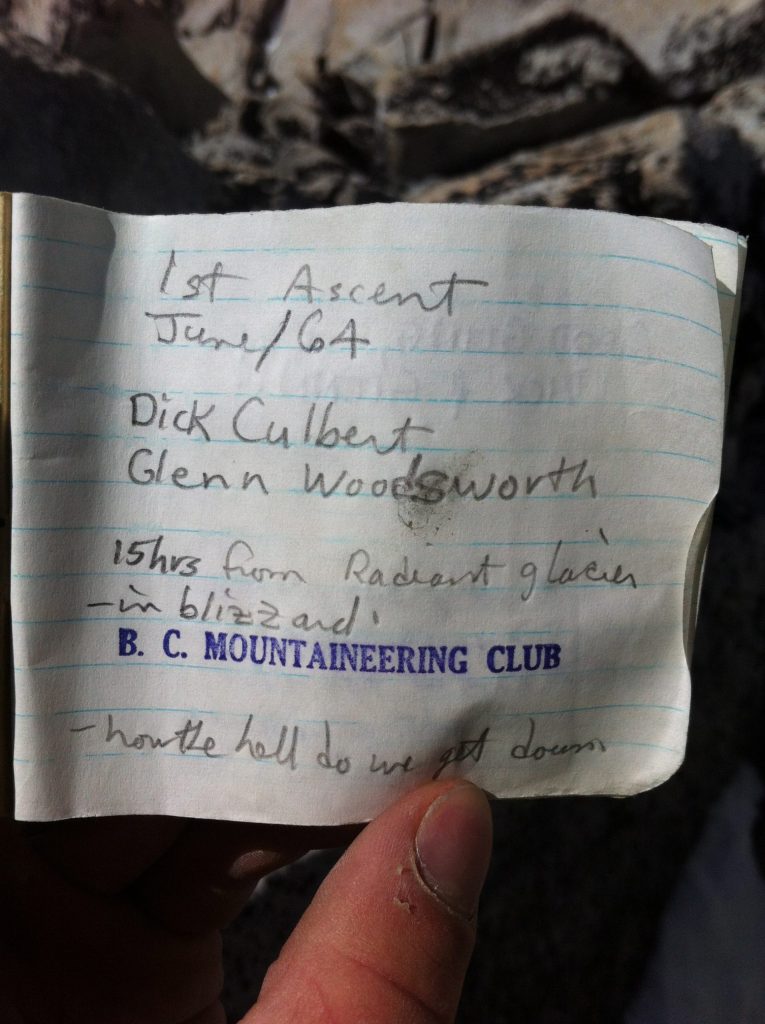
The note Dick Culbert left in the summit register on Serra V upon completing the first ascent with Glenn Woodsworth in 1964. The last line reads “How the hell do we get down.” Marc-André Leclerc, who sent the photo to Woodsworth after a solo ascent of the peak in 2014, described the climb on his blog: “[Nearing the top] I would frequently find myself stemming on rock in my mountain boots while swinging my tools into water ice in the back of the corner, dry tooling on secure flakes or dancing up icy slabs balancing on my tip toes on perfect waves of granite.” [Photo] Marc-André Leclerc
We were very tired, not only because of the struggle in the icefall but because we both had killer headaches, probably from the rapid rise from sea level at Bella Coola to here. Fatigue and the blizzard made the descent difficult, and snarled and stuck ropes didn’t help matters. At midnight we had a handful of nuts and hunkered down in the snow to await the dawn. We were reasonably comfortable during the night, and we both dozed off occasionally. But we were very worried about the descent. From Dick’s journal: “The outlook for tomorrow is not warming. First there will be the problem of fresh snow avalanches on the head- wall, then the task of finding a route down 3000 ft. of icefall in a whiteout, and—finally we must locate a small tent on a large glacier in the fog. Comes the dawn and we must look like a couple of frost heaves on the ridge.”
It snowed all night and all the next day, but the wind abated. We were hit by several powder snow avalanches in the ice gully, one of which we had to jump into a ’schrund to escape. Shortly after we started down the main icefall, I dropped into a crevasse. Dick was holding the belay and couldn’t help me, and it took half an hour and all my strength to get out. In the lower part of the icefall, the trough we had plowed with such effort on the ascent was still visible and gave us a fast route down to the flat part of the Radiant. By this time the fog had lifted, and we had no problem finding our tent. The descent from the col had taken the same time as the ascent. We had a bit of dinner and crawled into our sleeping bags.
The following day we didn’t wake up until midafternoon. Our headaches and worries were gone and so was the storm. Late in the afternoon we took advantage of the sunshine to wander up easy Chaos Peak above camp. The views were outstanding. Our route on the Radiant headwall had been completely scoured by avalanches and by a huge chunk of ice that had fallen from the headwall; we were highly aware of just how lucky we had been. It was cool on top of Chaos, so we didn’t stay long, but we could see peak after peak to the north, including some unclimbed, that we hoped to attempt in the next month or so. But they could wait; this expedition was just beginning, and it was time to get back to camp.
FIFTY YEARS LATER DICK CULBERT and I sat in his warm, comfortable living room and discussed the climb. We thought that, although the up-and-over-Tiedemann route was objectively safer, we probably wouldn’t have made the summit, given the weather over the next couple of days. We both agreed that our route, despite the strong objective hazards, was a justifiable choice, because we did the climb and survived to talk about it in Dick’s living room. To us, at that time and at that age, the prize was worth the risk.
More interesting to us was our discussion on first ascent mania and why we got caught up in it. Neither of us considered ourselves to be particularly competitive by nature, and it remained a mystery to us as to why we, both mainly exploratory mountaineers, got pulled into that game.
Regardless, we thought that our route on Serra V, although it may have been the “correct” line at the time, was never likely to become a popular line. As with the 1939 first ascent route on Mt. Tiedemann, it is likely to be relegated to the status of “for historical interest only, not recommended under modern conditions.”