

[This Mountain Profile essay about the Tiedemann Group originally appeared in Alpinist 92, which is now available on newsstands and in our online store. You can read all five essays here. Only a small fraction of our many long-form stories from the print edition are ever uploaded to Alpinist.com. Be sure to pick up Alpinist 92 for all the goodness!–Ed.]
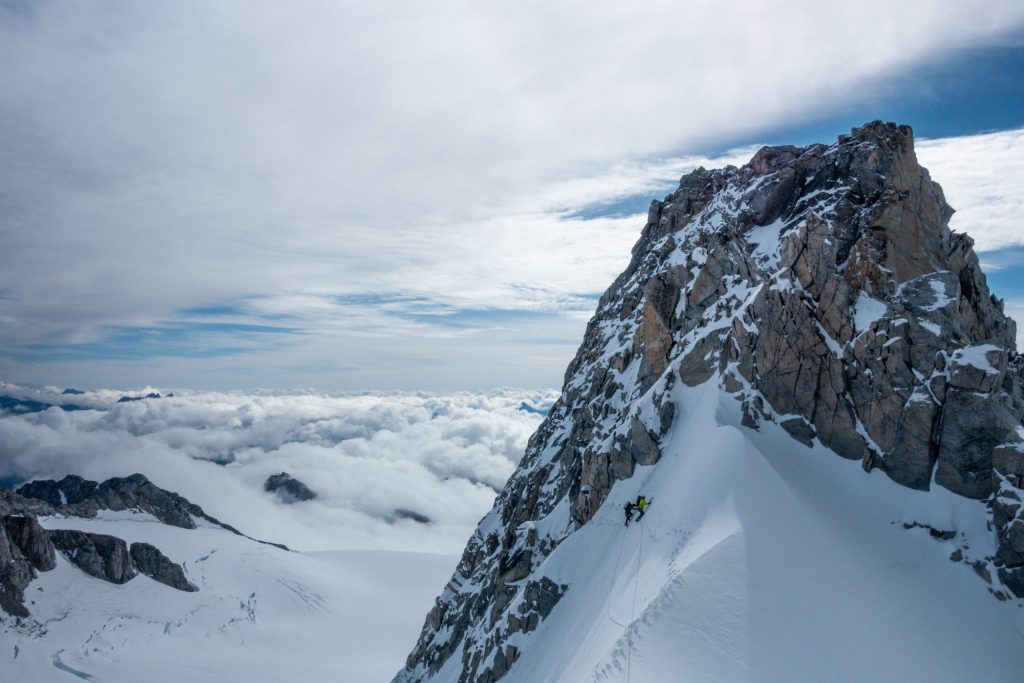
Sebastian Pelletti (left) and Matteo Agnoloni climb toward the Serra I–II col on the first day of their traverse of the Serra peaks in 2023. [Photo] Ethan Berman
GREAT SUCCESS? GIANT FLOP? I’M still not sure what to make of the five days I spent in the Waddington Range with Matteo Agnoloni and Seba Pelletti in early August 2023. It was a second attempt of what I was calling the “Waddington Loop,” a traverse of all the high peaks of the range. We would start and end at the Plummer Hut, on a rocky shoulder of the Upper Tellot Glacier below Claw Peak. After crossing the glacier and climbing the Serra peaks, we envisioned continuing along to Asperity, Tiedemann, Combatant and Waddington before descending the Bravo Glacier and slogging back up to the hut to cold beers stashed in the wet snow.
Peter Croft, Greg Foweraker and Don Serl completed the Waddington traverse in 1985. We planned to go in the opposite direction and loop back to where we started, as opposed to getting dropped off and picked up at opposite ends of the range. “Reverse traverses are so sexy these days,” I joked to myself while poring over Serl’s The Waddington Guide before my first visit. In reality, I simply had no idea where to start. I figured the best way to experience the heart of the Coast Mountains would be to complete a grand tour, scoping out future objectives on the tall granite walls and jagged summits along the way. Little did I know that two years and two attempts later I would still have only visited one small part of the range.
Matteo and I made our first attempt in the summer of 2022. After getting flown in to the Plummer Hut, we spent a night on the Upper Tellot Glacier, below the north faces of Serra I and Serra II. In the morning, we moved quickly up moderate ice and rock on Serra I. We rappelled back to the glacier, where we had left most of our gear, and climbed Serra II from the col it shares with Serra III. In the afternoon, we enjoyed warm, windless weather and made quick work of the moderate ridge climbing to Serra III. We tagged the summit and bivied along the ridge to Serra IV. After a summer spent at sea level in Squamish, it felt incredible to breathe thin air, watching what felt like an eternal sunset spread hues of red, orange and purple across a vast expanse of rugged and remote peaks.
In the morning, we tackled Serra IV, which rose in a sheer pinnacle from the ridgeline. The best climbing yet. It was not even noon by the time we were moving toward Serra V, right on schedule. According to Serl, “Serra Five has an aura far out of scale with its size and is recognized amongst the coterie of serious Coast Range climbers as being the hardest major summit to reach in the entire Range.” Access to the menacing tower is guarded on all sides by steep, broken glaciers, ice-choked couloirs and long ridgelines. Before its first ascent in 1964 by Dick Culbert and Glenn Woodsworth via the Radiant Glacier and upper north face, climbers of the 1950s and ’60s had attempted it by traversing through the Serras, only to be thwarted by the vertical rock of the east face, with loose flakes the size of grand pianos teetering on the brink of crescendo.
Our idea to reach Serra V was simple—we’d follow the adage common in the Canadian Rockies: “When in doubt, traverse.” We planned to rappel down the Serra IV–V couloir to the north and climb ice runnels into the established routes on the upper north face. But on our second rappel down the couloir, we dislodged three toaster-sized rocks while pulling the ropes. Naturally, we watched them bounce sideways toward where we were anchored in on the opposite side of the gully. Instinctively, I pulled in close to the rock, shrugged my shoulders to cover my neck and closed my eyes. There was no time for thoughts. Matteo’s wail echoed up and down the couloir, his pain radiating outward from the deep gash that one of the blocks had left in his thigh. He looked at me, silent, and reality came rushing in: we were no longer on schedule.
For the first time in my life, I pressed the little orange SOS button on the inReach, then assessed our predicament. Although Matteo was bleeding, his femur and arteries were still intact. We bandaged the deep wound with our extensive supply of climbing tape and tightened a Dyneema sling around his upper thigh.
I looked around. We were in the middle of a steep, rockfall-prone ice couloir, surrounded by towering granite. If there was any chance of getting whisked off the mountain, we needed to move. Down? Impassable. Climate change had turned the Radiant Glacier into a mess of giant cracks that would swallow us whole. Up? Difficult but doable. Two pitches of ice climbing would lead us back to the Serra IV–V col, a living room–sized terrace of horizontal granite in the middle of a vertical world.
I led back up, shouting down to Matteo every minute to make sure he was still conscious. With a tight belay he made slow progress upward, kicking into the ice and standing up on his good leg, then sitting on the rope to reset. We finally reached the col, somewhat relieved to be out of the firing range. Although we were now in a relatively safe spot, we didn’t need to state the obvious: if it was even possible, we were looking at a highly technical rescue. We mentally prepared to spend the night, which seemed likely. In the back of my mind, I started planning the epic reversal back to the Tellot Glacier if fate left us with no other option.
Matteo and I sat mostly in silence for a few hours, under the hot sun of a coastal heat wave. Magically, the buzz of the rotors broke the stillness in the air. It briefly lifted our spirits, until we saw that the helicopter didn’t have a long line. Not today, maybe tomorrow, I thought. After a couple of flybys, much to our surprise, the chopper moved in. The pilot touched the front corner of his left skid to a boulder at the edge of the col and, hovering what felt like meters away from the east face of Serra V, waved Matteo into the machine. I was stunned by the pilot’s decision to fly straight into the chaos. I tried not to imagine the churning wash of the helicopter’s blades dislodging loose rock above.
He flew us down to the glacier one at a time, where we regrouped with the SAR team before flying northwest to Bella Coola. If there had been a lick of wind that afternoon, in what was probably the nastiest piece of terrain in the entire range … It’s safe to say we got impossibly lucky. “Didn’t you duck and cover?” I asked Matteo, hours later, as he awaited an air ambulance from Bella Coola General Hospital to North Vancouver for emergency surgery. I don’t remember his answer. I do remember his voice cracking as he said, “We’re going back next year.” The surgeon could see all the way through to the bone before he repaired Matteo’s partially severed quad tendon.
A year later, on the last day of July 2023, Matteo, Seba and I were back on the Tellot. After waiting weeks for a weather window to materialize, the three of us just managed to sneak through swirling clouds to touch down in what felt like winter compared to the previous year. We didn’t even make it to the base of Serra I before another storm system blew in and reduced the visibility to nil, forcing us to bivy in the middle of the heavily crevassed glacier.
The next morning the sun rose to illuminate clear skies, and we soon found ourselves on top of Serra I. This time we stuck to the ridgeline between Serra I and Serra II. We found thoughtful mixed climbing on the north and east faces of Serra II, including a pleasing iced-up chimney pitch leading directly to the summit. Descending the tower, we found that last year’s trivial granite scrambling was now treacherous verglas-coated slab, making it clear we weren’t going to keep pace with our previous attempt. The next day, I cringed as Matteo led the summit block of Serra III, an unprotectable right-slanting groove covered in snow. What if he pitched into the sharp rocks below?
The memories of our epic in the Serra IV–V couloir were certainly taking their mental toll. We held our collective breath as we rappelled into that familiar terrain, but this time we connected to the ice gully leading up the lower north face of Serra V, and successfully intersected with the existing routes on the shoulder below the final ropelengths. I led a few tricky mixed pitches to reach one of BC’s most difficult summits as the sun was setting. We shared grins and high fives all around.
It was midnight by the time we reached our bivy at the Serra V–Asperity col. Over freeze-dried pad Thai we reconsidered our plan to continue traversing across the range. We were at the end of our third day of climbing and saw two days of high pressure in the forecast before the next coastal system would blow in from the Pacific. But having already been slowed down by unpredictable weather and tricky conditions, we weren’t convinced we had the margin to continue. Even if we called it now, we still had a long descent ahead of us to get back to the hut.
After waiting out the heat of the day in the tent, late the next afternoon we started descending to the south. The lower half of Serra V was substantially melted out, and after we’d down climbed much of Carl’s Couloir, the snow abruptly ended. At sunset we made several rappels around teetering blocks of snow balanced on smooth glacial-polished stone. We hopped over a sea of moonlit crevasses as we made our way down the Tiedemann Glacier. The summit of Waddington sat deep in slumber a cozy 2000 meters above us.
We had ample time to ponder our climb during the early morning hours spent slogging back up to the Plummer Hut, perched above the Tiedemann Glacier. We had traversed the Serra peaks from east to west, yet had once again fallen short of even coming close to our original objective. Whether it was a success or a flop, I couldn’t help but feel a sense of closure. The stress of the previous year’s disaster had now fractured into the deep satisfaction of having concluded the chapter of Serra V with my good friends. I still hope to one day see the views of Combatant, Asperity, Tiedemann and the Serra group from the other side of the valley.