

[This Mountain Profile essay about the Tiedemann Group originally appeared in Alpinist 92, which is now available on newsstands and in our online store. You can read all five essays here. Only a small fraction of our many long-form stories from the print edition are ever uploaded to Alpinist.com. Be sure to pick up Alpinist 92 for all the goodness!–Ed.]
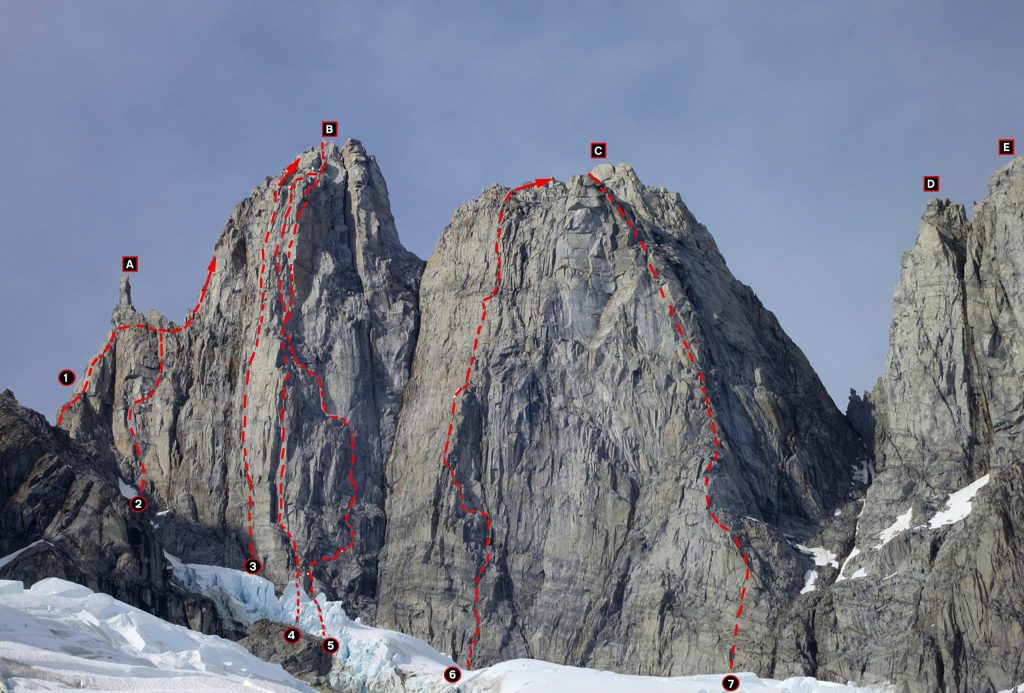
A. Stiletto Needle B. Stiletto Peak C. The Blade D. West Dentiform Peak E. East Dentiform Peak 1. Beckey-Patterson (D+: 5.8, Beckey-Patterson, 1965) 2. West Notch Buttress (TD: 5.10+, Foweraker-Isaac, 1997) 3. Southwest Pillar (ED1: 5.10 A2, Glick-Hirvonen-Richardson, 1998) 4. Drag Queen (5.11d R A2+, Cassels-Menitove-Simms, 2004) 5. The Canadian Club (ED1: 5.11-, Bennett-Herrington-Zimmerman, 2012) 6. IncogNeato (ED1: 5.10+ C1, Bennett-Herrington-Zimmerman, 2012) 7. Sundog (ED1: 5.11a, Brennan-Kettman, 1994) [Photo] Blake Herrington
The massif of the Stilettos is a dense set of multi-spired summits with a proliferation of shortish mixed or rock routes. The peaks are the easternmost set of spikes, towers, needles and otherwise rock lumps that, when viewed on a map, arc like a wing from the knot of summits forming the Serras, Grand Cappuccino and Phantom Tower. Excepting the col between the Stiletto Needle and Serra I, the Stilettos are entirely surrounded by glaciers. The Stilettos are the little siblings of the spectacular mountains right next door, but they attract attention because, once you’re in the area, access is easy and they require a shorter weather window for climbing.
The first summit climbed in the Stilettos was the Stiletto Needle (3375m), described by Don Serl in The Waddington Guide as “an impressive granite obelisk” at the northwestern end of the massif. The Needle now has a number of fine routes on it; the most notable on the Tellot Glacier face, climbed by Hank Abrons and Richard Millikan on July 31, 1961. Exactly where the Abrons-Millikan goes is not entirely clear, though we have a pretty good idea from the write-up in The Canadian Alpine Journal. Thirty years later, Chris Bretherton and Wayne Burleson added a 180-meter variation to the Abrons-Millikan. The Bretherton-Burleson (5.9) is, according to Serl, likely the most desirable, aesthetic and balanced route on the Stiletto Needle.
The tallest of the Stilettos, Stiletto Peak (3397m) was first climbed in five hours on August 11, 1950, by the strong American party of Phil Bettler, Bill Long and Allen Steck. Starting on the Upper Tellot Glacier, the trio ascended cracks and slabs on the north face. They then traversed to a snow patch in the center of the face. The crux came above, described in the 1951 Sierra Club Bulletin as a “rope traverse followed by a minute fingerhold traverse protected by rock pitons.” Serl noted that modern equipment undoubtedly now makes the ascent of the central snowfield to its top quicker and easier than the original route, but it was a bold undertaking for its day.
Many years later, in July 1998, Lorne Glick, Kai Hirvonen and Whit Richardson joined Fred Beckey and what Serl described as a “team of young lions” on a trip to the peaks, where they added a new route—the Southwest Pillar (ED1: 5.10 A2, 400m)—on the much larger Serra Glacier face. The trio arrived on the summit late in the day and opted to bivy there. The next day they descended by rapping from the northwest end of the summit ridge directly to the Upper Tellot Glacier.
In July 2004, up a striking dihedral right of the Southwest Pillar route, Justin Cassels, Ari Menitove and John Simms established Drag Queen (5.11d R A2+, 650m). Menitove wrote in the 2005 American Alpine Journal that “exiting the corner proved to be the mental crux … requiring 40′ of basically unprotected but brilliant 5.10- climbing.” The team aided a short section up a steep corner but noted this would likely go free at a more difficult grade.
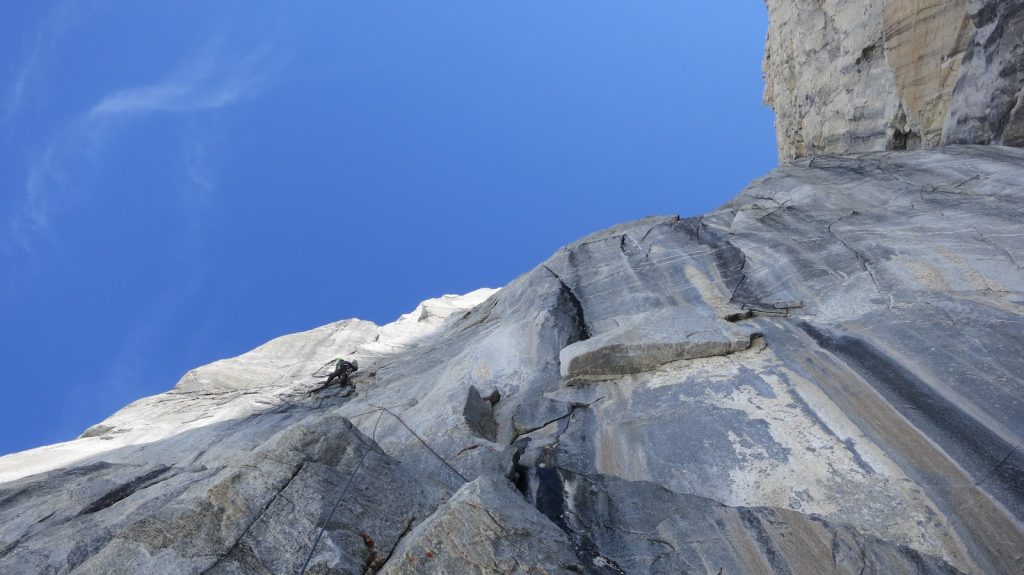
In more modern history, Scott Bennett, Blake Herrington and Graham Zimmerman climbed The Canadian Club (ED1: 5.11-), also on the southwest buttress of Stiletto, in August 2012. The route offers both excellent climbing and a “healthy amount of shattered alpine choss,” according to Zimmerman’s write-up in The American Alpine Journal. The trio also climbed IncogNeato, a 500-meter route rated ED1: 5.10+ C1—with Zimmerman noting that “the one pitch of aid … involved ducking left beneath several roofs…. [It] will likely go free in the 5.12 range.”
On the southeastern shoulder of Stiletto Peak lies a feature large enough to earn its own name: the Blade (3340m). It was first climbed in August 1988 by Seattle climbers Jim Nelson and Heather Paxson via the east buttress. The pair were among a large group who hoped to climb Waddington but got weathered off. Classic; missed out on the big peak, so they did a first ascent instead. The pair didn’t name the route but said it’s “probably 5.10ish.”
Farther down the chain of mountains the toothy names start. There’s Dentiform (3215m) with its pleasing bilateral symmetry. The shoulder of Dentiform is known as the Molar (ca. 3180m), which has also been tapped with the name the Dentist’s Needle. Given how enjoyable a dentist’s needle is, I prefer the Molar. Then it’s Bicuspid Tower (ca. 2850m), which shockingly has a twin top, and at the bottom of this dental enterprise is the Gnat’s Tooth (ca. 2694m), a minor rock fang halfway between Dentiform and the Tiedemann Glacier.
The routes on these aiguilles are many, and they are not well defined by topos. This has resulted in confusion as to who did what and when. Many reported climbs are variations to established routes, further complicating the question of What exactly did we climb? Suffice to say, these summits are what many climbers get up to when the weather windows are short and boredom levels rise.