

[This Mountain Profile essay about the Tiedemann Group originally appeared in Alpinist 92, which is now available on newsstands and in our online store. You can read all five essays here. Only a small fraction of our many long-form stories from the print edition are ever uploaded to Alpinist.com. Be sure to pick up Alpinist 92 for all the goodness!–Ed.]
THE RACE WAS ON! Although I guess it wasn’t really a competition, as the other team wasn’t in a race, and if they were it was only against the weather and not to make the prized second ascent of Serra V. Don Serl, Peter Croft and Greg Foweraker had flown in a couple of days earlier during a fine stretch of summer high pressure. We figured they must have already dispatched with Waddington and would now be getting into the real business of traversing the Tiedemann Group. Along the way they’d have to surmount the least accessible summit in the entire Coast Range, a formidable tower guarded on all sides by near-impossible icefalls and dizzying verticality—Serra V.
Twenty-one years earlier, the legendary duo of Dick Culbert and Glenn Woodsworth punctuated the end of an era when they made the first ascent of Serra V, which was the last remaining major unclimbed summit in the Waddington Range. With Don, Peter and Greg approaching Serra V from up high on the traverse, my partner John Howe and I were going bottom up, and if we could find our way through the Radiant Glacier icefall, we would then take the deep gut of azure ice splitting down between the north walls of Serra IV and Serra V to gain the latter tower on its eastern edge.
Miraculously, we somehow found a way through the chaotic labyrinth of jumbled seracs to a bivy tucked into the toe of the great ice spine that rises like the back of a stegosaurus to define the north face of Asperity. The next day we entered the soulless-cold shadows of the Serra IV–V couloir, bludgeoning up the steep bulletproof ice and making good progress. After a dozen or so full pitches, with our calves screaming for mercy, we gained the Serra IV–V notch by midafternoon, and at a semi-hanging stance we made the fretful change-out from our mountain boots (dropping a boot would have made for a world of trouble) into our rock shoes. John broke into a wry logger’s grin now that he was departing into his more favored territory of steep, unclimbed granite.
But his grin quickly turned to a frown of furrowed dismay. John had climbed perhaps forty feet up the dead-vertical wall out of the notch when it became clear that going any farther would be suicidal. It turned out the deep gash defining the eastern edge of the summit tower was totally rotten and decomposed rock—some kind of strange fault line searing through the otherwise monolithic granite of the Serra peaks, a nod to a freak moment in geologic time. Not only was the crumbling rock impossible to protect, but John was literally pulling chunks out of the wall with every upward crank. Deeply disappointed, we grudgingly accepted this would be our high point—the greatly coveted second ascent of Serra V was not to be our prize.
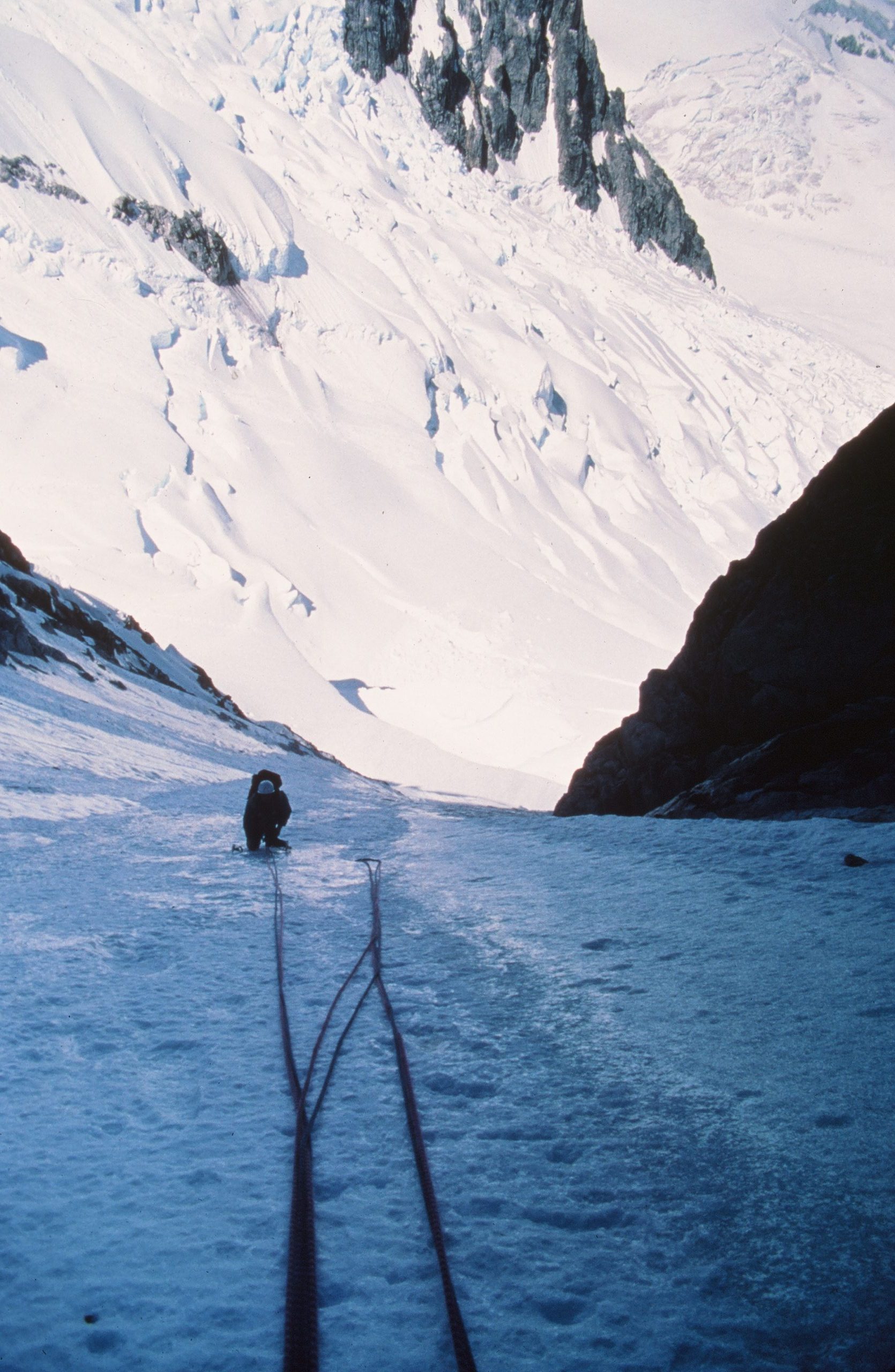
Howe carries gear up to the base of the Serra V tower in 1985. [Photo] Michael Down
All this time our good friend Scott Flavelle was guiding on the friendlier summits of the nearby Upper Tellot Glacier. From the summit of Tellot Dome, Scott could make out the tiny dark dot of our tent, and a couple of even tinier figures milling about the camp. He assumed John and I hadn’t found passage through the icefall and were instead lazily hanging out and catching up on our reading. But those tiny moving figures were not, in fact, John and me …
Two days later we returned to camp, famished and manically ready to tuck into the feast of food we’d supplied ourselves with via a helicopter drop. This was back in the day before radio communication was available in the range, and Mike King wasn’t scheduled to pick us up for another week. No worries, though; we’d packed plenty of extra food just in case of delay, including every conceivable culinary delight you could purchase in a can. As we began the trudge across the flats back to our camp, we could think only of the smorgasbord awaiting.
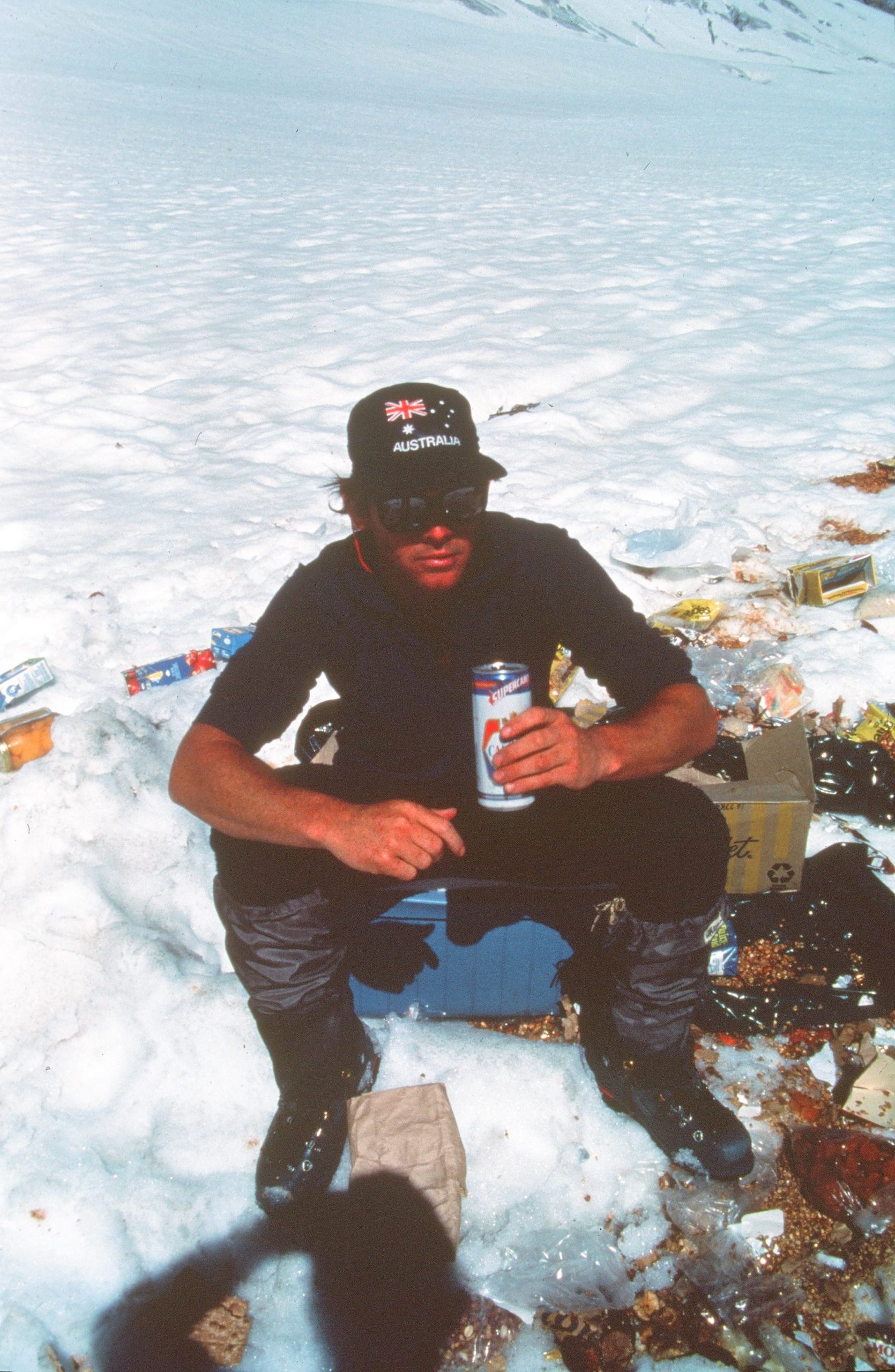
As we plodded closer, something seemed askew. There was random stuff strewn all over the snow. We shambled, half starved, into camp and our hearts sank as we realized that not only had all the pasta and cereal and cookies and crackers and sausage and cheese been entirely consumed, but a creature with strong enough claws and jaws had punctured through every can and devoured its contents. Only two cans of beer and a jar of peaches bottled by John’s mom as a special treat for our return to camp had survived. The glass jar gleamed in the sun in the middle of the stinking pile of garbage soiled with the feces of the only animal patrolling the Waddington Range that could have wreaked such complete havoc above an icefall, the ghost of the high mountains: Gulo gulo, the wolverine.