

[From March 27-28, Matt Cornell, Jackson Marvell and Alan Rousseau climbed a new route on Alaska’s Mt. Dickey. They named their route Heavy is the Hand (WI6+ M6+ A1, 5,000′).—Ed.]
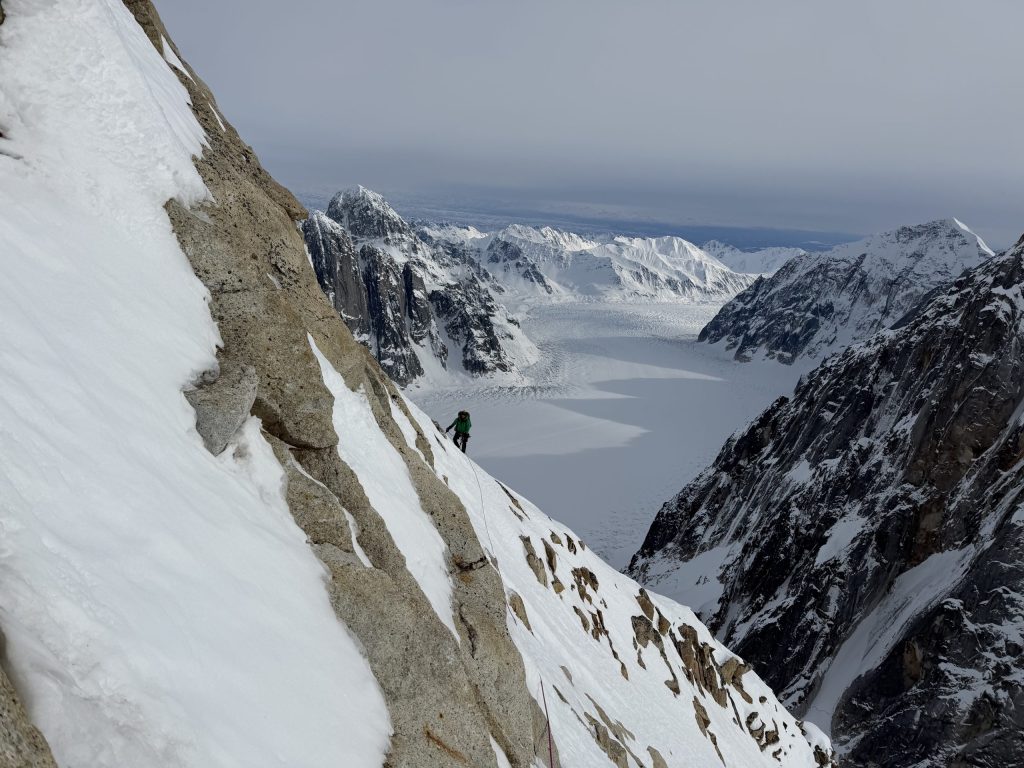
Heavy is the hand that chops the ledge. Heavy is the hand that hammers the beak. “Heavy is the hand” has become a bit of a mantra—half joke, half truth—and something muttered when a mix of levity and hard work is needed. It makes us smile, and it has become a tongue-in-cheek way of our team conveying, “watch me on this one.”
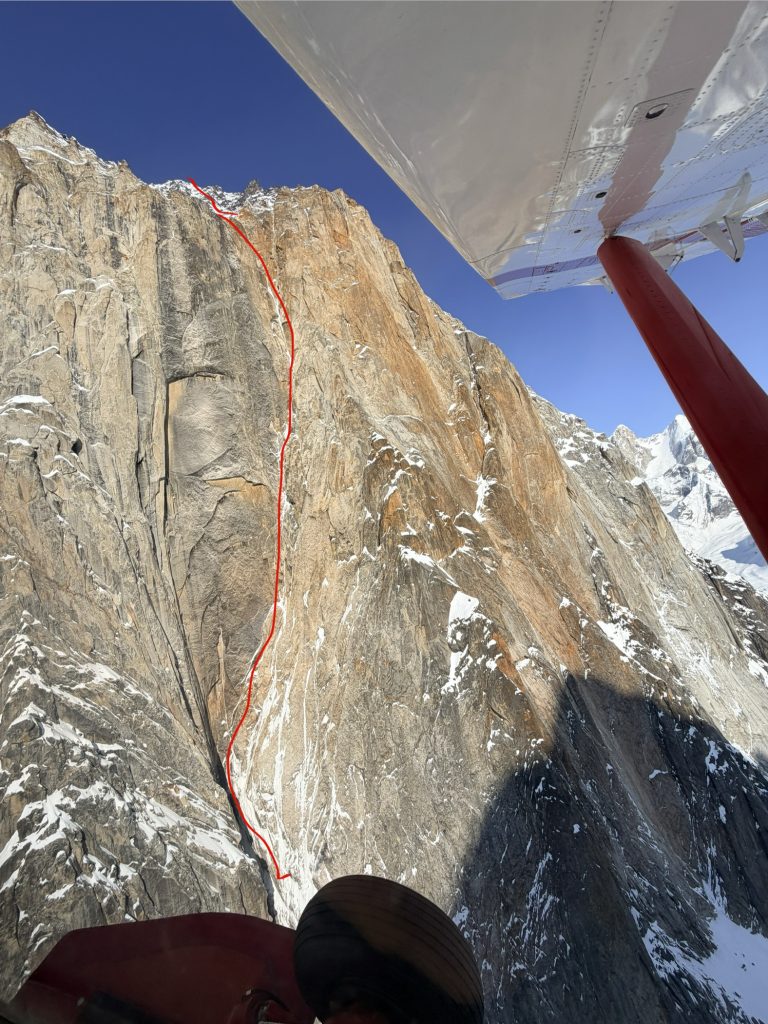
We didn’t know what we would find in the Alaska Range this year. But in late March, Talkeetna Air Taxi flew us slowly past a few potential features. As we passed Mt. Dickey’s south face, Matt Cornell, Jackson Marvell and I unanimously threw our thumbs in the air and said: “Drop us in the Gorge.”
Waking up on the Ruth Glacier, the minus 10-degree air felt fierce compared to the amenable 80 degrees I left at home in Salt Lake City. Despite wearing a copious amount of down feathers, it felt damn cold as we fired up the cook stoves. I stomped my feet in place in our dome tent while the blocks of ice in our pot melted. In late March the sun doesn’t hit the bottom of the gorge until 11 a.m. I cursed myself for forgetting this and wished I had stayed in my sleeping bag an hour longer.
Eventually the ice changed to slush and the slush to a boil. The whole process of making coffee and breakfast took a couple hours. We had nothing but high pressure forecasted, so we felt no rush. Time in the Alaska Range feels different than anywhere else. It’s one of the reasons I am drawn to spending time there. When it’s time to climb it is full-on. Otherwise, there is very little to do. It’s the most relaxing place in the world as far as I’m concerned.
As a team we have a lot of experience on Mt. Dickey. In 2019, Jackson and I established Ruth Gorge Grinder (AI6+ M7, 5,000′) on the mountain’s east face. Matt, Jackson and I went back to the east face in 2023 and completed the first ascent of Aim for the Bushes (AI6 M6 X, 5,250′). That same year, Matt, Sam Hennessey and Rob Smith did the second ascent of the epic line Blood from the Stone (M7+ WI6+ X A1, 5,000′), which was first climbed by Sean Easton and Ueli Steck about twenty years earlier. Just last year, I guided my good friend Chris Chicoskie up Dickey’s northeast face via the Byrch-McNeill route established in 2003. There’s no shortage of other zones to explore, but we keep coming back to Dickey. Establishing new routes on this mountain is as rewarding of an experience as I have found in climbing. That’s probably why it has become a bit of an obsession.
This time around, on March 27, we started off from camp early in the morning. Despite the cold temperatures, we all warmed up on the 30-minute skin to the base of the wall. The initial 1,000 feet of climbing passed by very quickly. Unroped, we moved together up a tight névé gully system that provided access to 2,500 feet of sweeping ice dihedrals.
Once our gully system terminated in the deeply recessed south face, we pulled out the rope and began to climb in pitches. Just sixty-five feet into leading the first pitch, I abandoned my hopes of a one-day push and felt grateful for packing a proper bivy kit. An initial steep mixed pitch brought us into a series of ice corners. The traversing white lines of ice remained consistent for the next couple of pitches. I have never experienced quality ice oriented like that; it felt like we were ascending ice ramps floating out in space.
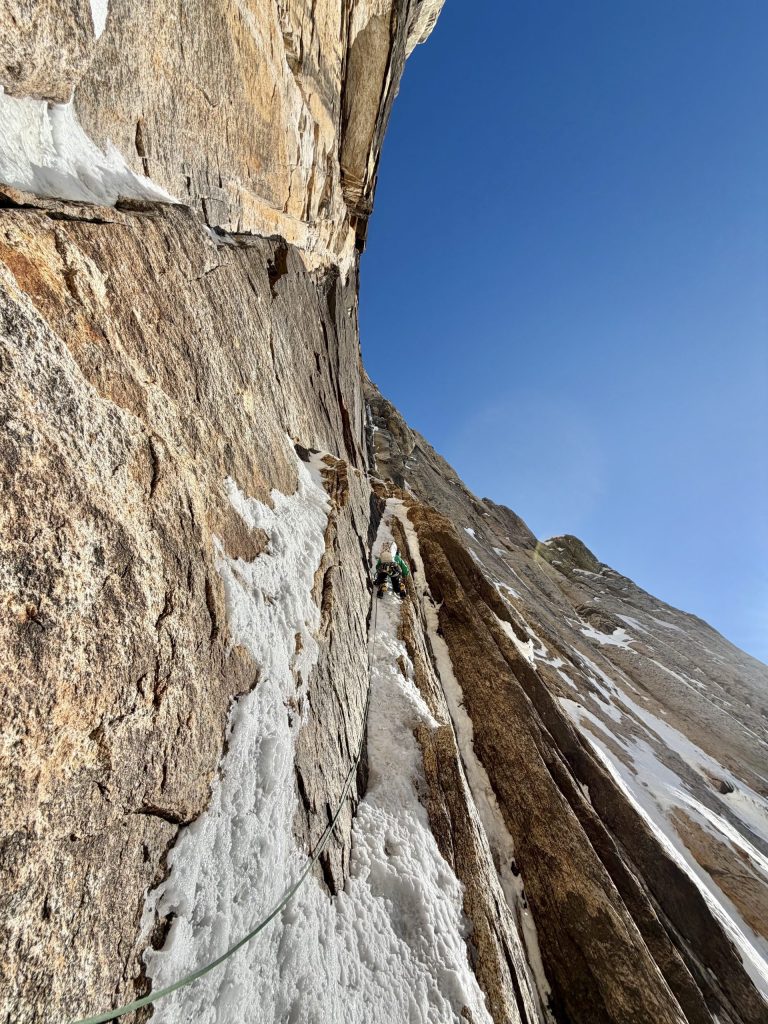
After a few pitches, we found ourselves under a steep, intimidating feature that presented one of the big question marks on the route. Matt took the rack and led out. He had two choices: a thin ice feature angled at more than 90 degrees, or an overhanging flake system that looked like it would require some aid climbing. Matt decided to tackle the ice pitch and ended up leading WI6+ for nearly 200 feet. At the end of the pitch Matt constructed a three-beak anchor—one of several on the route. Jackson took the next pitch, which began with some tenuous mixed climbing. Finally, about 20 feet up, he got some solid protection and aid climbed about 15 feet to bypass a dagger that jeopardized Matt and I hanging at the belay. This was the only portion of the route where we used direct aid. Jackson went on to quest over thin sheets of ice that were rapidly delaminating in the afternoon sun. A lot of this ice was less than a foot wide and sometimes only an inch thick. It was often so delicate that it fell away as we climbed, leaving only shut, water-polished, seams below. We had a long way to go, but we were motivated to finish the line, inspired by the caliber of climbing we’d already completed.
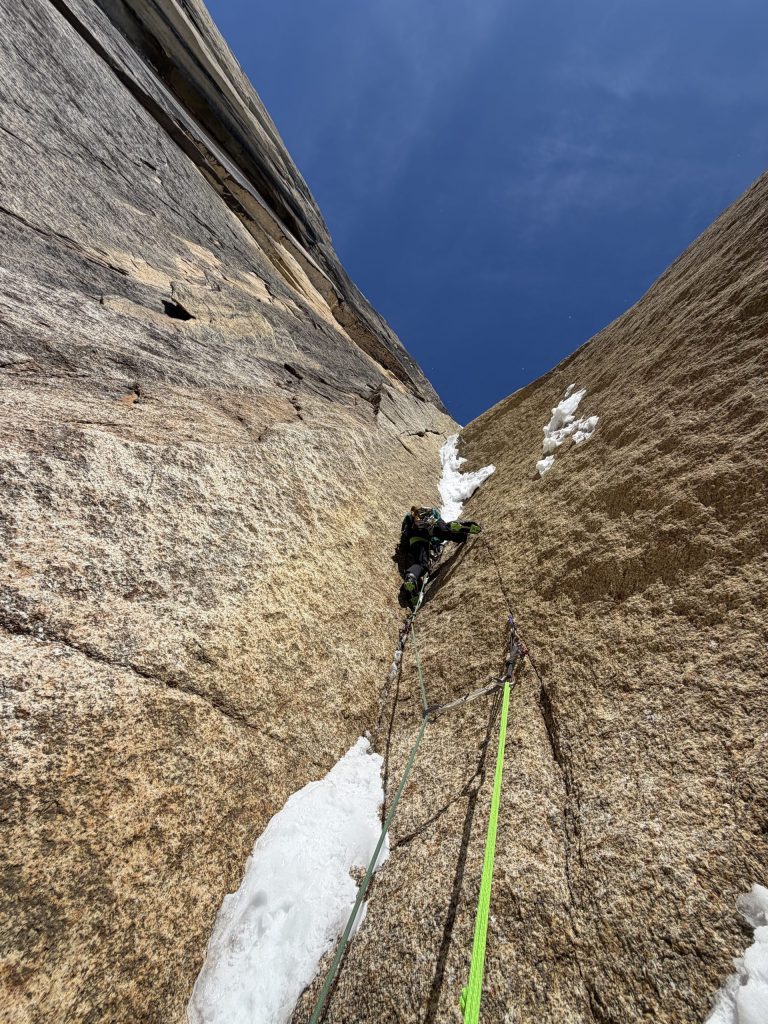
Jackson led up two more deceptively steep ice pitches to get us to the only spot on the route where chopping a tent site seemed viable. It took us around two hours to hack a platform out of the névé. Around 11 p.m. we piled into a small two-person tent, where we shared two sleeping pads, but each had our own light sleeping bag for the night. We made water, hydrated freeze-dried food and figured out where to best position our damp boot liners for the night.
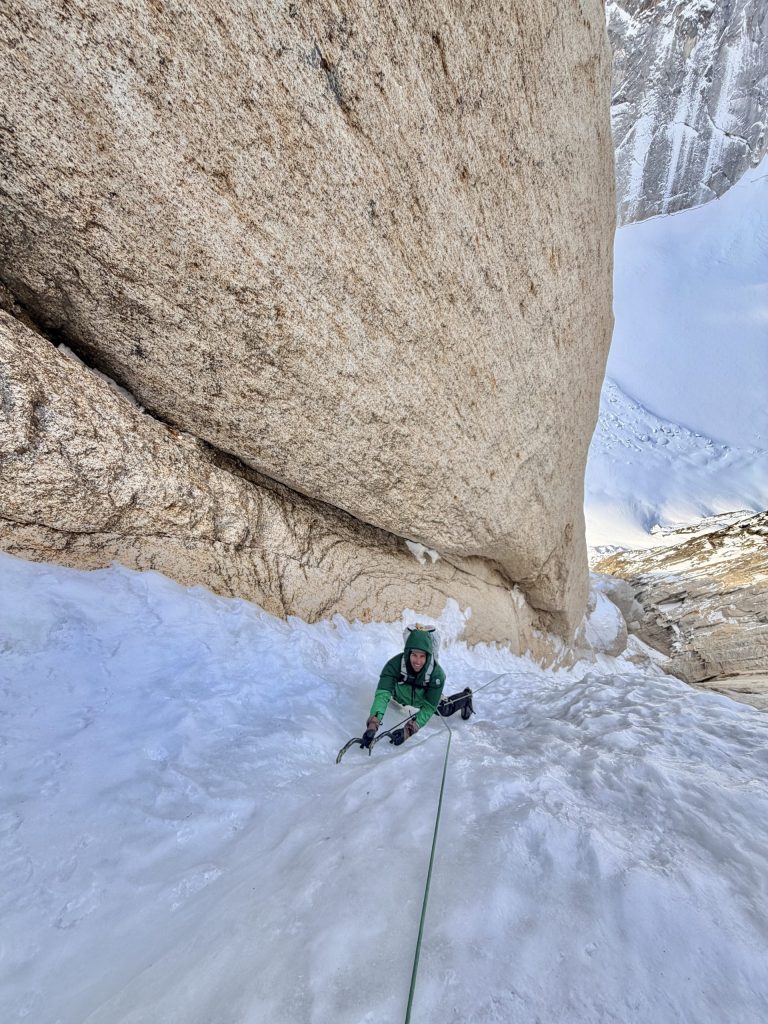
The alarm went off at 5:20 a.m. and we were all pleasantly surprised to have stayed warm and slept through the night. Over the next hours we drank coffee, forced down some calories, brewed water for the day and packed up all the gear. Leaving the bivy, I started off the first block of climbing amid a high level of uncertainty. Above me, one feature appeared to be a large dagger of blue ice with only vertical snow leading up to it. From below, it was unclear whether it was possible to find a way around it. When I arrived below it, I found a hidden sheet of ice attached to the left wall that allowed me to avoid the dagger. Even better, there was a nice crack in the rock next to the ice. My mood changed quickly from trepidation to elation as I climbed the steep blue ice and plugged my cams pretty much wherever I wanted.
In contrast, the next pitch was a very thinly iced open book. Over 165 feet, I only found two pieces of good gear. At the end of the pitch, I encountered a hollow, overhung, névé feature. As I built an anchor, I felt a blend of adrenaline, cold, overexertion and relief swirl into a slightly nauseating mélange. The white line of ice seemed continuous above, and I began to feel very confident we could top out the wall. From here, Matt and Jackson shared leads on four more rope lengths of steep ice that brought us to the end of the sustained climbing. All three of us stood on top of the wall at 4:20 p.m. Our celebration was abbreviated, however, seeing the late hour and knowing how far we had left to go.
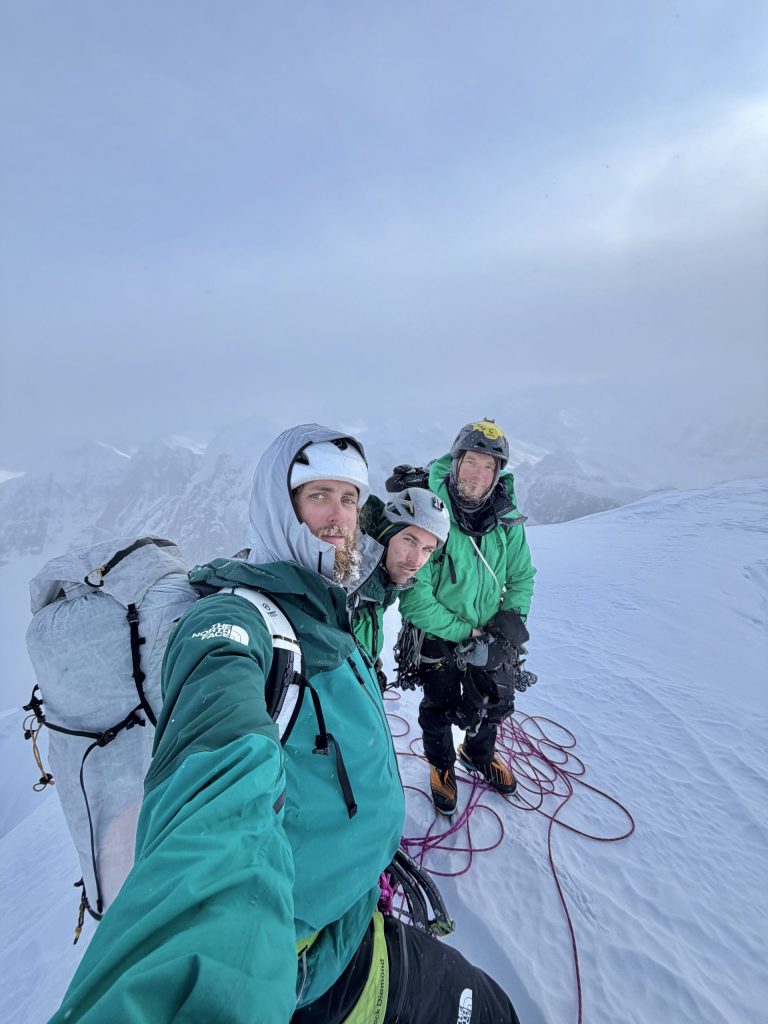
We still had about 1,500 feet to gain before reaching the summit. Most of this was through 50- to 70-degree snow and mixed terrain. It had been a cold, dry, winter which resulted in some deep wallowing through weak faceted snow. It felt prudent to keep our team attached to the mountain with running protection. On this section of Dickey, even a small avalanche could result in catastrophic consequences given the El Cap-sized wall below. Jackson took the first half of this, often wading through snow up to his waist. Movement through this terrain sometimes feels more like swimming than climbing. We stopped for a quick bite of food and a sip of water when Jackson ran out of gear to place. I took over in front, and very soon after the snow turned from bottomless sugar to squeaky firm wind board. About 20 minutes later, at 6:30 p.m., we were on top of Mt. Dickey.
This was definitely a special route for us. It’s one we have looked at almost every year since we started climbing here. It is also a route I have been intimidated by for a few reasons: it’s so continually steep and it’s marked by the objective hazards of big sunny ice lines. It was worth the wait for the conditions we found it in. Long periods of cold, sunny, weather are needed for the route to form. Even with temperatures only reaching the teens in the Gorge while we were there, pitches were melting out in the afternoon sun. We experienced time consuming leads, sparse protection and sustained climbing for 16 long pitches up through the main dihedral system.
One of our favorite things about climbing on Dickey is that we know we can be back in our base camp three hours after leaving the summit. The moderate snow slopes of the west face provide antithetical terrain to the granite fortresses found on its other aspects. Two-and-a-half hours after topping out, we got back to our skis, clicked on our headlamps and, with our hands feeling heavy from the fatigue of the last two days, we started the quick glide back to base camp.