

[This Sharp End story originally appeared in Alpinist 93 (Spring 2026), which is now available on newsstands and in our online store. Only a small fraction of our many long-form stories from the print edition are ever uploaded to Alpinist.com. Be sure to pick up the hard copies of Alpinist for all the goodness!–Ed.]
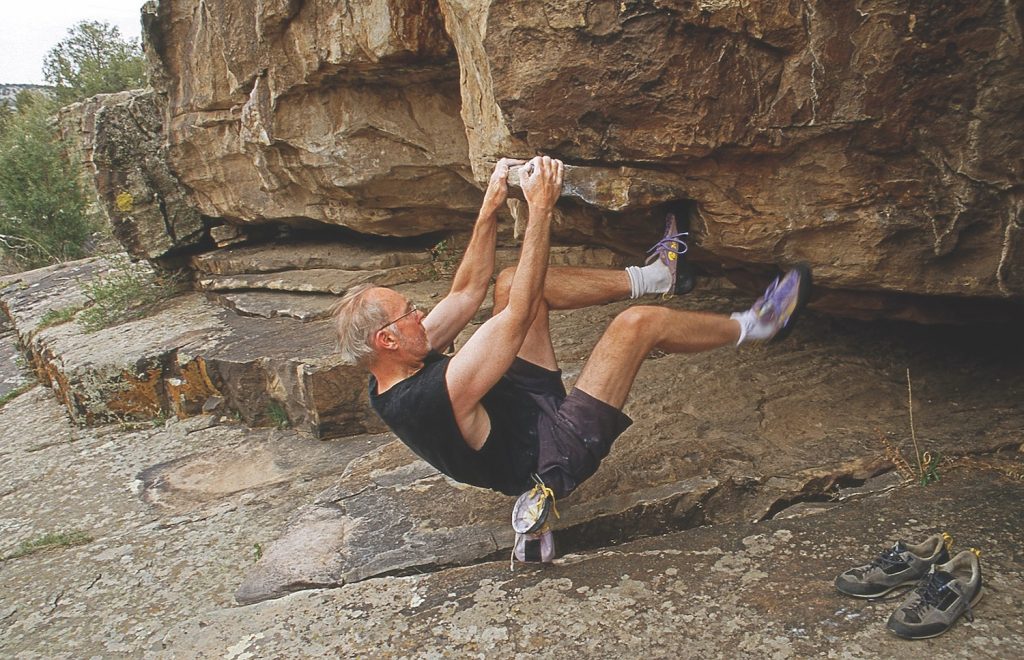
FOR MOST OF MY LIFE, I couldn’t be bothered with lowball, eliminate boulder problems: rocks that rarely exceed seven feet tall, so abundant in edges, flakes, cracks, corners and arêtes that you must avoid using certain features to concoct a set of challenging moves. Your feet and butt are so close to the ground that the crux is often avoiding the “dab” in the dirt. Until sometime in the last few years, my eyes always searched for the highest, prettiest rocks and the proudest peaks, neglecting some gifts that were right in front of me the whole time.
Lucky for me, the beautiful thing about lowball boulder problems is that it’s never too late to learn.
Chronic injuries, middle age, work stress, major home repairs, family deaths and illness, not to mention the insane state of America and much of the world, have me feeling tied down and tired. I know I’m lucky to have a home and loved ones, and better health and fitness than most. But it’s becoming more difficult to believe that these good things will continue. Finding small springs of joy and hope in a desert of bad news has become daily work for me, as I’m sure it has for many of us.
This winter is disturbingly dry. Drier and warmer than any I can remember. As I skinned up the main run at our local ski resort on Christmas Eve, it became impossible to avoid expansive mud fields. Instead of finding the escape I’d sought, the bare facts of global catastrophe were staring me in the face all the way up the mountain.
In recent months, a cluster of humble boulders near a small town where I grew up has given me solace. As a teenager I couldn’t wait to escape that quiet, dusty town. I was unaware of the boulders and so many other things nearby. Now, whenever I have a few hours on a clear “winter” day, I drive half an hour to return to a place I once loathed.
The past is simultaneously near and far as I drive old roads layered in new pavement. I pass the houses where I lived with Mom, who was mostly not around, being too busy working two jobs and finishing medical school; I pass the parking lot where I rolled back and forth on my skateboard, practicing ollies, kickflips and pop-shove-its until my legs turned to rubber. I was searching for something then, and I’m searching for it now …
Outside town, I enter a bastion of ranchland, home to gun lovers and giant red Trump flags. I turn right before a pullout that serves as a shooting range and park off the side of the road between No Trespassing signs. Access is still permitted here as far as I know, but it’s best to remain quiet and low-profile. Alas, I thrash through an opening in the brush with a tall, cumbersome crash pad on my back. Once through, I scurry up a muddy hill to a handful of rocks that just a year ago wouldn’t have held my attention for more than five minutes.
Guidebook information is sparse. The starting holds and exact sequences are mostly left to the climber to discover, and that is what I’ve come to love. With little information and no one around, all there is to do is take in the silence among the junipers and study, truly study, the subtleties of each chunk of sandstone.
In Alpinist 12, in a profile of Fontainebleau by Emmanuel Ratouis (translated from the French by Katie Ives), Ratouis describes a pivotal moment in his life:
As we walked on sand between the oddly twisted roots of the forest pines, a sense of space engulfed me. I placed my hands on my first boulder and felt the exceptionally fine grain, polished over millions of years by the ocean. I began to climb. Pleasure—of touch, of movement, of solving an enigma—wove itself tightly with a fear of falling that made my muscles tense and my moves clumsy. I was seduced immediately. By the end of my first day … I had accomplished only a modest 4a, a sort of pillar with holds that I considered, at the very least, elusive.
Setting down my pads, I begin the process of finding the most enticing features and textures on a boulder. Each rock feels like a gift to unwrap. There isn’t much chalk dotting the holds. I must use my imagination. The “V8” listed in the book is merely a vague suggestion of what I may find. With proper patience and attention, I often discover much more.
I am searching for the line. That can be many things. On the rock, it is an enchainment of moves that flow together like music.
I start by climbing the boulder by the easiest, most logical route. Then I start avoiding holds as the movement I’m looking for slowly emerges like a statue from a block of marble, or a picture in an inkblot. There is sublimity in finding a precise thread of balance on a panel of smooth, sloping stone, in which the friction of skin, pulling in just the right way, matches the coefficient of gravity and holds my body aloft. Each splice of time between moves slows down to a small eternity. There, I find freedom from attachment—from self-evaluation, from ego, from troubles. I feel as though I’m instinctively performing an ancient ritual dance.
In Alpinist 60, the late David Roberts, one of the great mountaineers and authors of our time, writes of a visit to Fontainebleau as he’s dying of cancer:
The lesson for me last August in Bleau was how often climbers cannot see the forest for the rocks. In our zeal for the route that angles up the precipice, we tend to ignore the landscape it occupies. We look at streams and bushes and snowbanks merely as nuisances to be navigated to get to the climb. And we fail to respect—or worse, we dismiss—all the other ways human beings over the ages have looked at cliffs and mountains.
He quotes a passage by Claude-François Denecourt from 1867: “Among the giant trees and the rocks as old as the world, one finds peace.”
THWAP. Gravity has deposited me on the pad. I sip water, savor the calm breeze and try to ignore the echoes of gunfire across the valley. I consider the moves once more. Why do I slip when I extend this way? I get lost in the details and the gunfire fades out of mind once more.
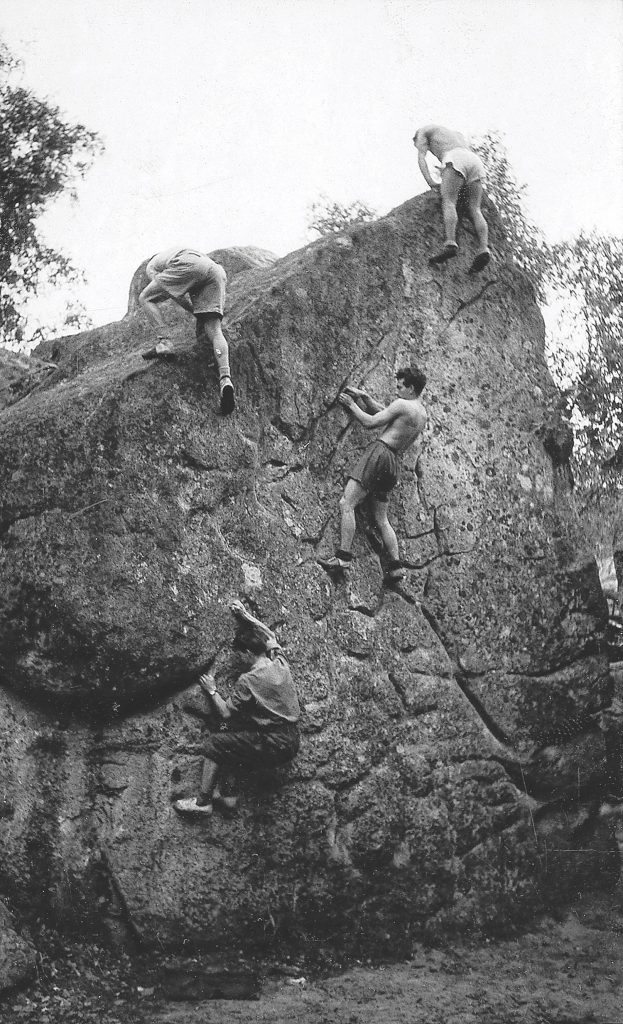
At last! I find myself connecting the sequence, playing the music. It’s been a fine day of learning. I feel hopeful, healthy. Snowy mountains beckon in the distance. Ratouis’s words come to mind:
When I made the first ski descent of Shivling, in India’s Garhwal Himalaya, that day was simply an extension of the one when I reached the top of the 4a pillar with the elusive holds.
The boulder may have served as the gymnastic apparatus, but I’m keenly aware that the medicine I find here is connected to everything around me. I’m thankful to the people who came before, who preserved the place well enough for me to access and enjoy it.
In the end we take nothing with us; it’s more about what we leave behind. With that in mind, I gently brush away my chalk marks as well as I can before I go.