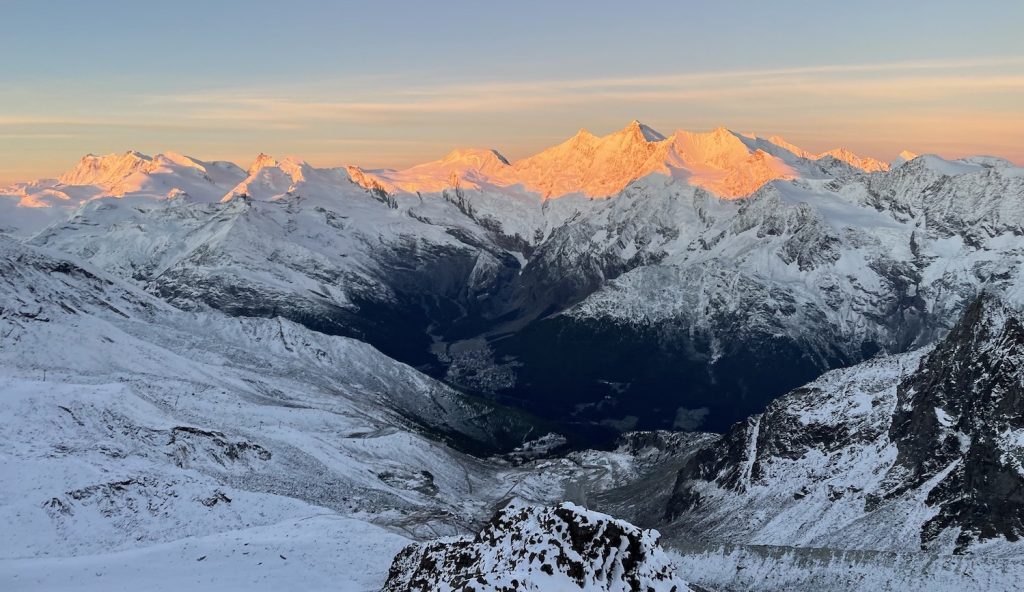
[This Sharp End story originally appeared in Alpinist 92 (Winter 2025-26), which is now available on newsstands and in our online store. Only a small fraction of our many long-form stories from the print edition are ever uploaded to Alpinist.com. Be sure to pick up the hard copies of Alpinist for all the goodness!–Ed.]
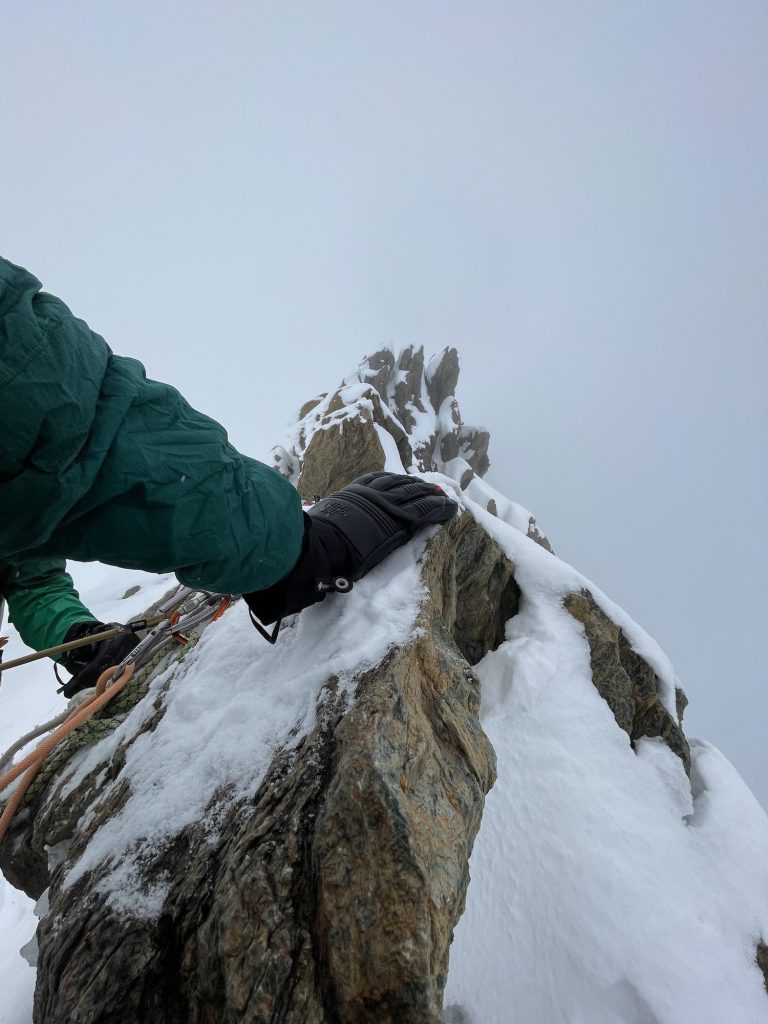
[Photo] Derek Franz
SEPTEMBER 25: If it wasn’t for the rope connecting me to my four companions, I’d be lost in the cloud.
My legs and arms pump furiously to swim up a steepening slope through the fresh powder. Sweat drips from the tip of my nose and the edges of my glacier glasses. Fingertips are numb. I’m craving a drink of water and yearn to don thicker gloves, but I don’t want to slow the team’s pace. My eyes strain to discern the best places to kick my frontpoints—where the snow won’t collapse and send me sliding. The visibility is terrible; even my photochromic sunglasses are too dark, yet without them the refracted light on the snow is too bright and the cold wind too sharp on my watering eyes. So I feel my way upward, trying not to hesitate or slip.
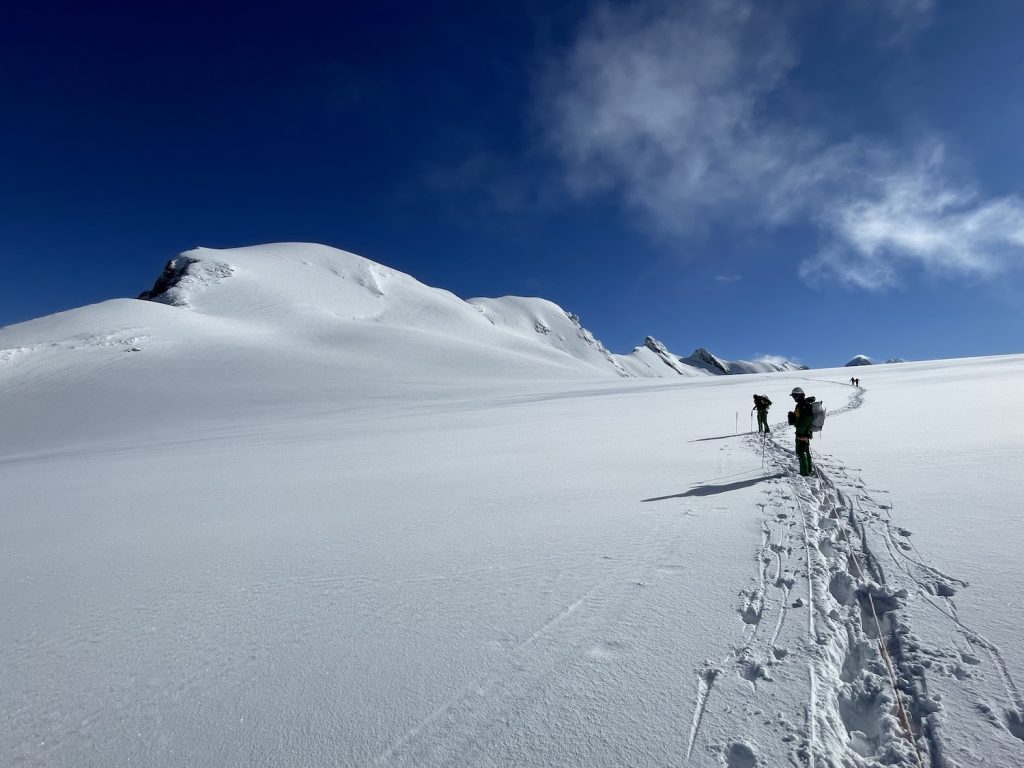
Less than two hours ago the sky was blue and virtually empty as we crossed the glacier on the Italian side of the Breithorn (4164m). The crisp skyline of the Alps beckoned like a calm ocean when we parted ways with the rest of The North Face team and continued past the normal south face route. There, we began breaking trail across the glacier to try a slightly harder line on the east ridge, the Breithorn Half Traverse. Then the white room closed in so gradually it was like being caught in a bubble.
The fog had enveloped us by the time we crossed the high bergschrund, but I still felt confident that we would accomplish our plan: to gain a col on the east ridge and climb an easy mixed route up the knife-edge to the top (rated 5.4 in dry conditions). From there, the plan was to meet the other team and descend the normal hiking route on an open slope.
A radio crackles above me. “We’re almost to the col,” David Göttler says to Mike Arnold, who is leading the other group. I can keep this pace for a few more minutes, I think. Fifteen minutes later, we’re still going and the storm has intensified.
Above David, his longtime friend Óscar Gogorza is breaking trail. A stronger blast of wind hits us and I feel an instantaneous pull on the rope as Óscar and David kick into a higher gear. Any moment now; we have to be close to the col! I think.
It is a treat to witness these accomplished high-altitude alpinists in their element. David has climbed several 8000-meter peaks without bottled oxygen; this past June he climbed the Schell Route on Nanga Parbat (8125m) in alpine style with Boris Langenstein and Tiphaine Dupérier, then paraglided down from 7700 meters while his partners skied. David’s first two attempts on the mountain were in winter. As for Óscar, he’s a low-key badass, a Spanish journalist who doubles as a UIAGM high mountain guide with experience in the Himalaya and Karakoram. The difficult conditions allow these two to showcase their talents. But trying to keep up with them on a rope is a journey into the pain cave.
Behind me are Anthony Walsh and Thomas Pueyo. A Canadian in his late twenties, Anthony is Climbing’s senior editor; he set a speed record on Cerro Eléctrico in Patagonia with Colin Haley last December. Thomas is a French journalist and accomplished endurance athlete who’s in his early thirties. I’m a forty-two-year-old who’s had two heart surgeries to replace his aortic valve since 2014, though you wouldn’t guess it unless you saw the scar down the middle of my chest. There are plenty of days when I almost forget the lifesaving operations ever happened. Life itself can feel like a foggy dream.
Twenty-four hours ago I didn’t even know I’d be on this mountain, and only six days ago I had no idea that I would be in Switzerland.
In May, The North Face (TNF) invited me and a group of sixteen international journalists on a media trip to test out the latest Summit Series Advanced Mountain Kit in Nepal. I almost missed seeing the email. Of course I said yes and subsequently spent the entire summer training to go to Everest Base Camp and climb a 6100-meter peak called Lobuche East. I declined countless invitations to go rock climbing—my main love—to log as many miles as possible on Colorado’s 14,000-foot (ca. 4300m) peaks. All team members pre-acclimatized by sleeping in Hypoxico tents for three weeks prior to departure and were on supervised regimens, logging our biometrics on spreadsheets. There were doctor checkups and vaccinations; family visits to wish me bon voyage.
Then civil unrest erupted in Nepal about a week before our departure, reminding us that even the best-laid plans are only theoretical until actualized. A real expedition experience.
I was supposed to fly out on September 17. On September 12, after there were reports of people burning to death in the Kathmandu riots, I received an email from the airline saying all its flights into Kathmandu were canceled through the end of the month. My trip coordinators, who had spent about a year planning this expedition, told me to sit tight. They would have an answer for us on Monday. Monday came. Silence. Nerves chewed on me as I kept my foot on the gas with preparations to leave, just in case the trip was still a go. Tuesday—canceled. A disappointment but also a relief to have an answer. Twenty-four hours later I was put on standby to possibly go to Zermatt instead.
I’m well acquainted with a dose of chaos and things not going to plan, but this was the first time I ended up on a different continent.
Even after we reached Zermatt, our plans were day-to-day because the conditions were so variable. Each morning at breakfast, the guides—most of whom were TNF athletes—would break us into groups and give us the plan for the day. Anthony was my roommate, and we joked that it felt like we were on The Great British Bake Off: “Here is where you will be going today; pack X, Y and Z, and meet us outside in thirty minutes!”
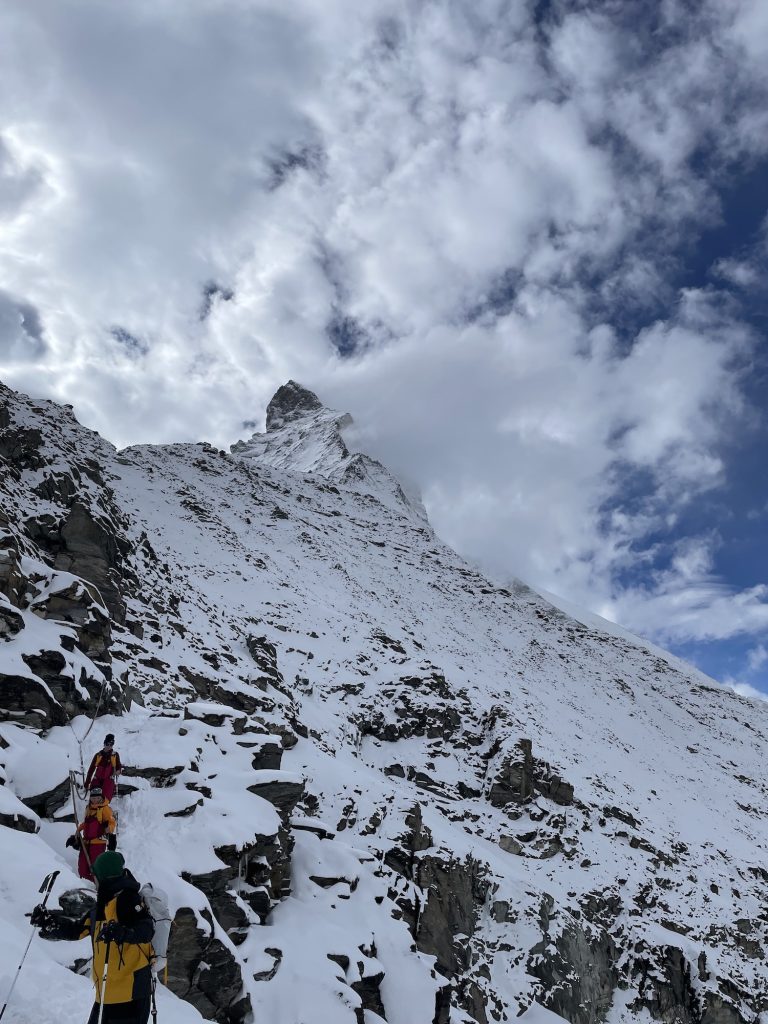
On our first full day, the entire crew of athletes and guests took the tram from town up into an autumn Alpine world covered in several inches—ahem, centimeters—of fresh snow. The goal was to pay a visit to the historic Hörnli Hut at the base of the Matterhorn. We followed metal staircases and causeways bolted into some of the cliffs, where ancient-looking pitons and other relics protruded from the rock, hinting of the boots and hands that have followed this route for centuries; I could almost hear faint echoes of forgotten voices on the breeze. Alas, with the fresh snow and the fact that some of the group members had never worn crampons before, we had to turn around before reaching the hut, or risk missing the last gondola back to town. The Matterhorn would remain a vision just beyond my touch, almost unreal.
But here on the Breithorn, my numb fingers and burning lungs remind me how real all of this is as I arrive at the col on the east ridge. Sharp plates of metamorphic rock protrude from the snow like shark fins; we grab them and traverse the knife-edge to the belay where the cliff curves up into the stormy mist. David gets off the radio: the other team turned around because of the avalanche risk and low visibility; if the five of us press on to the top, we won’t have a clear track to follow down in the fog on the south face’s freshly loaded slopes. The choice is clear: retreat. “If only we’d brought skis!” becomes our refrain as we plunge-step back the way we came.
BEFORE THE TRIP, I toured The North Face Innovation Lab in Denver. I never fully realized the extensive amount of research and design that a large company like TNF invests in developing technical clothing. They are constantly testing the possibilities of new materials and new ways of sewing garments according to the properties of those materials—and according to the needs of extreme athletes who provide feedback and help design the products. Other big brands certainly do the same, but TNF touts one of the largest networks of athletes and resources on the planet.
I learned that TNF has labs scattered around the globe, each with its own specialty, such as a lab in Malaysia that experiments with natural fibers. In Denver, I met researchers dedicated to measuring every conceivable aspect of the clothing designs. For example, one station tests the abrasion properties of various fabrics, where a machine rubs a swatch of fabric samples 10,000 times with a range of surfaces. They also evaluate for tensile strength, water repellency, absorption and more.


True exploration and experimentation require failure, a learning process. TNF considers its first iteration of the FutureLight Summit Series to be mostly a failure. The company has spent the past six years evaluating lessons learned—in some instances, learned by TNF athletes the hard and scary way, finding themselves freezing in tech wear that was theoretically going to protect them from the elements despite the outerwear’s super-light weight. These were clothes hyped as being able to ventilate sweat and simultaneously keep you dry and warm enough while bivouacking in mountain storms. The first kit fell short of those goals, if you can believe that. TNF wants people to know this story, because it is part of a bigger ongoing saga of research and innovation, to learn and be better.
That’s why the company recruited me and the other members of the media to help tell this story—to see for ourselves what goes into their efforts to create the best technology for humans to function in the most extreme environments. Most of us will never need anything close to the degree of performance offered by these clothes, myself included. But, like trying on a space suit, learning the intricacies of the gear provides a more direct perspective of where people go and what they are able to do in those places.
It was enlightening to witness every aspect of TNF’s product development and deployment in the field up close and personal, and not just the product side, but also how elite teams plan and prepare for expeditions. Once we were in Zermatt, the only detail that couldn’t be accounted for, it seemed, was the weather.
AS LUCK WOULD have it, the weather cleared for the last two days of the trip. About half of the overall group—thirteen of us—set off for an overnight stay at the Weissmies Hut in the neighboring valley to climb the Lagginhorn (4010m). By now, a virtual platoon of famous TNF athletes had joined our party in Zermatt. Besides David and Mike, Fay Manners, Caro North and Christina Lustenberger had been with us from the start, and by the weekend, Boris, David’s partner from Nanga Parbat, had jumped into the mix for our attempt on the Lagginhorn.
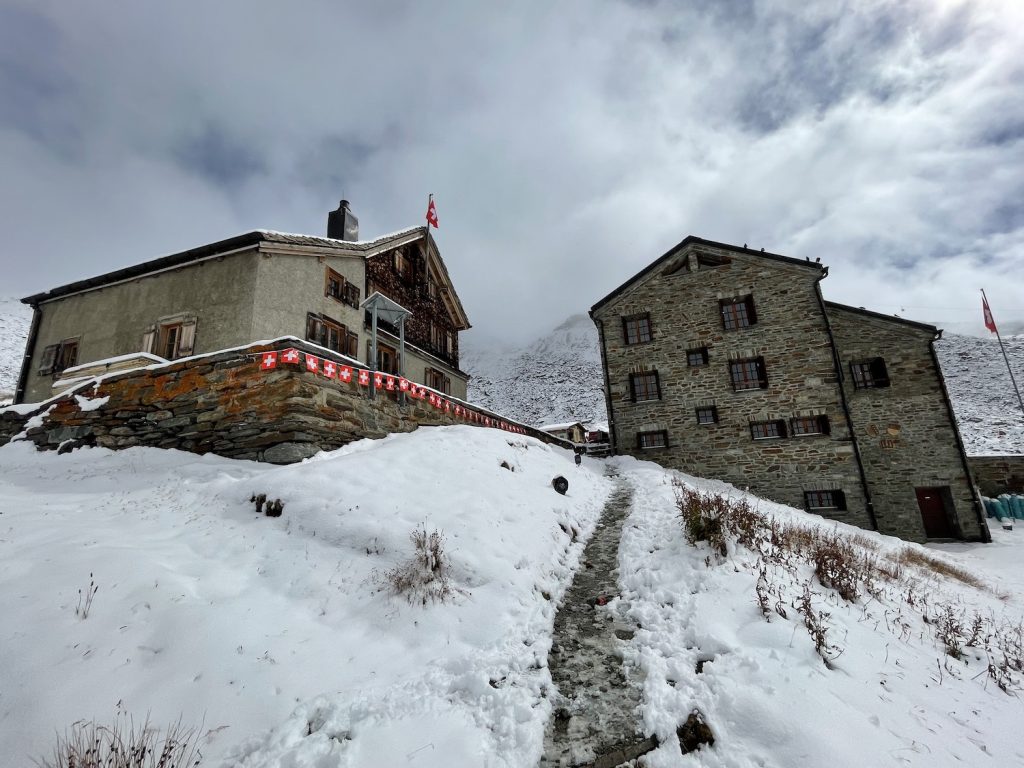
The Lagginhorn was still shrouded in clouds when we reached the hut in midafternoon, so I could only imagine what it looked like. The Swiss Alpine Club was having a grand party with a live accordion and alpenhorns. The beer was flowing along with hot platters of brats and potatoes. I grabbed a tattered book—the only English reading material on the shelf, Chris Bonington’s 2017 autobiography—and settled into a quiet corner, where I half listened to spirited banter in French over a dice game at a nearby table. At the center of the energy was Boris, who ultimately won the game after many of us had gone to bed. Through all the cozy hours, I enjoyed the special conversations that tend to only happen among friends in the mountains. Even the exchanges in French and Spanish that I couldn’t understand emitted a particular warmth. Happiness was all around. This was home.
In the wee hours of the night I tiptoed outside and beheld a clear sky full of stars. Dim outlines of snowy peaks extended toward the Milky Way like stony fingers of outstretched hands.
At 5 a.m. the dining hall served hot drinks and juice with Swiss bread, croissants, sliced meats, jam and butter. “It almost feels like cheating” had been uttered once or twice since we arrived. I shared that sentiment. A warm breakfast in a heated room for an Alpine start? No one was complaining.
By 6 a.m. we were marching up a frozen trail through the moraine in the dark, a snaking line of TNF green, black and gold, plus Caro’s pink. There was hardly a pause as we moved steadily along, nose to tail, passing a few other parties. By 7 a.m. the sky was alight with alpenglow, though we remained in shadow on the north slopes until late morning. Midway, as the ridge steepened and became more exposed, we put on harnesses and crampons. As we gained altitude, the slushy snow on verglassed rocks became deeper and drier, sugary and unconsolidated. Sunrise crawled across the glistening Alps as the team moved steadily on, everyone eager to prove their fitness. If I don’t stop to take pictures, I will regret it, I thought. And so, I was the last of the group to stand next to the wooden cross on the summit with Caro at 9:20 a.m.
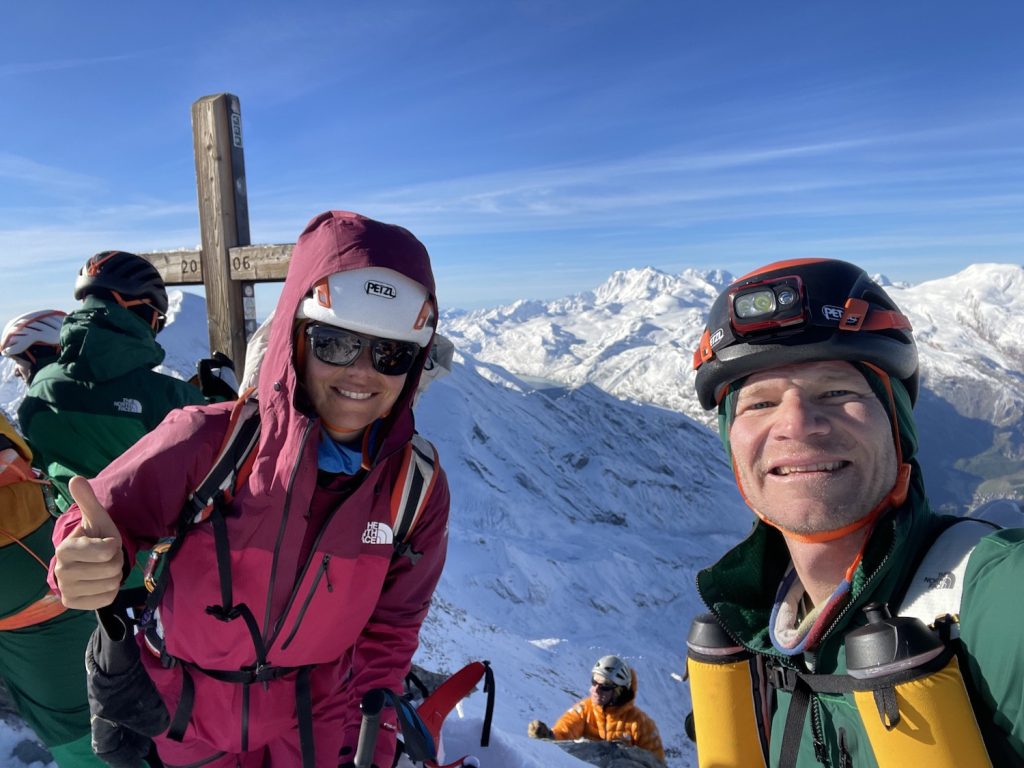
Everyone asked if I was feeling OK. I felt euphoric. I thought I was smiling. Only later when I saw the photos did I realize that my face was frozen, unable to move, and what I thought was a beaming expression of joy looked more like a grimace. A moment frozen in time, indeed!
By evening we were back in Zermatt for our last dinner together. Simone Moro arrived in time to regale us with a slideshow about his decades of chasing 8000-meter summits in winter and, most recently, learning to fly helicopters for high-altitude rescues.
At 5:30 the next morning, Anthony and I found ourselves jogging nearly two kilometers across town to the train station with overloaded duffel bags after the taxi driver failed to show up.
And suddenly, I’m back home. Did all that really happen?
I got to glimpse the top of a mountain—not just the Lagginhorn but another view that is much more elusive: a bubble in which so many people from different backgrounds get along seamlessly. Flourish, even. Mountains help me believe there is hope for this world, because up here, there are innumerable smart, kind, innovative souls with plenty of grit, and we are all connected in various ways. That’s what I hold on to when I’m stuck in traffic; when the smog roils over and I start to feel lost in the cloud.