

[This Sharp End story originally appeared in Alpinist 95 (Autumn 2026), which is now available on newsstands and in our online store. Only a small fraction of our many long-form stories from the print edition are ever uploaded to Alpinist.com. Be sure to pick up the hard copies of Alpinist for all the goodness!–Ed.]
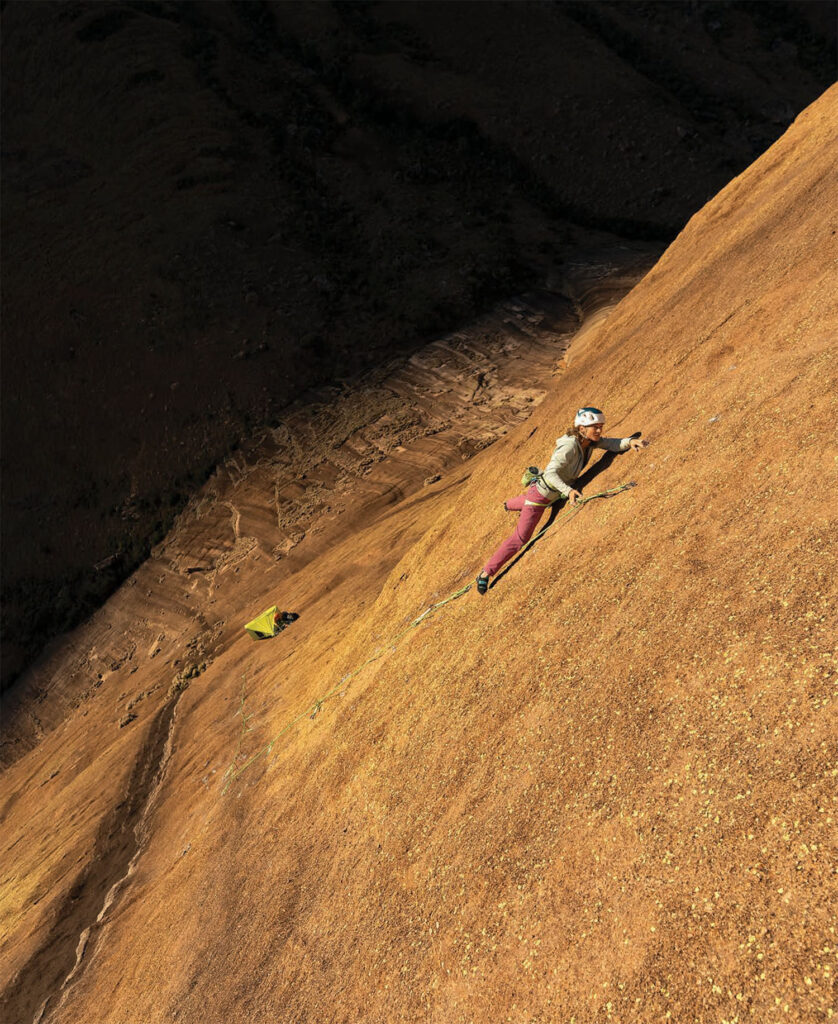
A climb can feel like a work of art, providing an aesthetic sense of flow through situations that inspire a range of emotions—fear, curiosity, doubt, relief, bliss, to name a few. The medium is primarily nature’s work, of course, but it also takes vision to establish a route: to identify how to piece together the natural features in the most rewarding way, with the best belay stances to break up the pitches, and establish just the right amount of fixed protection (or not) to the point that the line becomes an experience that people seek out.
That passage from my previous Sharp End bears repeating because matters of climbing style and ethics are continually evolving, and there are some questions that are getting harder to answer as the climbing population diversifies: When we establish a new route, who are we doing it for—is it for ourselves, purely as a personal experience, or do we bear greater responsibility to those who will come after us? And if it’s the latter, what type of climber do we have in mind for a given route or area? Are we open to change if our original vision doesn’t support sustainable development and enjoyment?
I GREW UP ASPIRING to emulate the style of the Yosemite Stonemasters of the late 1970s, especially that of John Bachar. I wanted to become good enough to free climb a new route from the ground up, without any prior inspection of the terrain that lay above, drilling as few bolts as possible, if any. This style is an expression of vision, bravery and control. Vision to see the line. Bravery to try. And control of mind and body to attempt it safely, knowing when to back off, commit to a runout or compromise by placing fixed protection.
These are challenges that give us something to dream about; goals to guide our development; imagined dragons to dread as we wonder how it will feel to breach the shadowy realm of personal unknowns.
An iconic example of this approach is the Bachar-Yerian (5.11c R/X, 550′) on Medlicott Dome in Yosemite, famously established by Bachar and Dave Yerian in 1981 after multiple pushes from the ground. Bachar hand-drilled only a few bolts on each pitch, hanging from hooks as he worked, eventually finding his way up the intimidating face. He even took a big fall on Pitch 2 when a knob broke, which he writes about in Issue 26.
The onsight, ground-up style was so pervasive in Yosemite climbing culture during the final decades of the twentieth century that Tuolumne Meadows Climbing (2024) contains numerous routes that were mostly climbed as onsight free solos, with little to no protection. These routes typically have modest ratings that belie their commitment. But today, as Tuolumne’s popularity skyrockets, the routes with better protection are getting crowded while aprons of clean, sparkling rock with old routes blazed by a few bold climbers from a bygone era remain empty. Some consider it a waste of perfectly good stone. That’s why there has been a growing movement in recent years to retro-bolt old routes to make them more accessible, and more fun. (Google “Snake Dike” for more on that.) Yet, like the Bachar-Yerian (and Snake Dike), there are some dangerously bold lines at various grades that many climbers still aspire to experience for themselves, me included. These are challenges that give us something to dream about; goals to guide our development; imagined dragons to dread as we wonder how it will feel to breach the shadowy realm of personal unknowns.
One of the most memorable experiences in my thirty years of climbing took place about eighteen years ago on an obscure, shattered buttress of granitic rock in western Colorado.
I was in my twenties and had recently redpointed some of my first 5.13 sport climbs when my friend Bryan Gall invited me to help him establish a new route above East Elk Creek. Ten years older than me, he was a mentor in some ways. I never knew him to push harder than 5.11, but he was tireless when it came to exploring uncharted rock and ice. On this day, he drove us to the trailhead at the end of a rough road, and after some hiking he pointed out the route he had in mind.
He’d established a 5.9 approach pitch the previous weekend. The second pitch was to follow a sharp arête—my lead! Bryan promised to teach me how to place a bolt when the time came. I’d explored unknown multipitch crack lines and done plenty of free soloing by that point, but I’d never committed to a route that was likely to need bolts.
My nerves buzzed as I left the belay. The wall was less than vertical and I remember following an easy ramp to reach the base of the arête. There were some giant hollow flakes wedged along the ramp like Jenga blocks, but the going was easy as I tiptoed up around the right side of the arête. Just when I thought it was time to haul up the drill, I found a place to stem out left to a shallow angling corner that led to the arête. There, I found a finger-size cam placement that gave me enough confidence to continue. Again, a bodylength higher, I found another piece of protection just as I considered drilling a bolt. Soon I was pinching blocky holds on the arête, smearing either side of the knife-edge as I shifted my weight from side to side, slithering upward at a steady pace. My endurance felt endless, thanks to my sport climbing fitness, and I kept finding just enough small gear to feel secure. At last, I reached a stance at the top of the arête where the rock quality changed, built a gear belay and brought Bryan up.
“Jesus!” he grunted as he cleaned the sparse cams and nuts, shaking his head.
He guided me through my first bolt placements, and we rappelled. I suggested we name the route Deebee Geebees, a play on our initials (my first and his last). The route is now recorded in the 2025 Western Sloper guidebook as 5.10d R/X.
Bryan wanted to clean off the loose flakes and add bolts to the pitch, but at the time I was resistant, feeling that it was a special thing to find an arête that had just enough gear placements to be reasonable for a confident climber. Would I feel the same if I returned to the route now? Probably not—not after the close calls and broken bones I’ve had since then. Besides, the other routes in the vicinity are fully bolted sport pitches. While the onsight experience was special to me, a spicy pitch to nowhere is unlikely to appeal to anyone else going up there. And while I tiptoed through those loose flakes, what would it mean to have untold numbers of climbers doing the same? That’s why I recently gave the OK to a local guide who suggested retro-bolting the pitch.
A strict adherence to the values of the past doesn’t always lead to a better future, and, like climbing grades, the best path forward can be subjective.
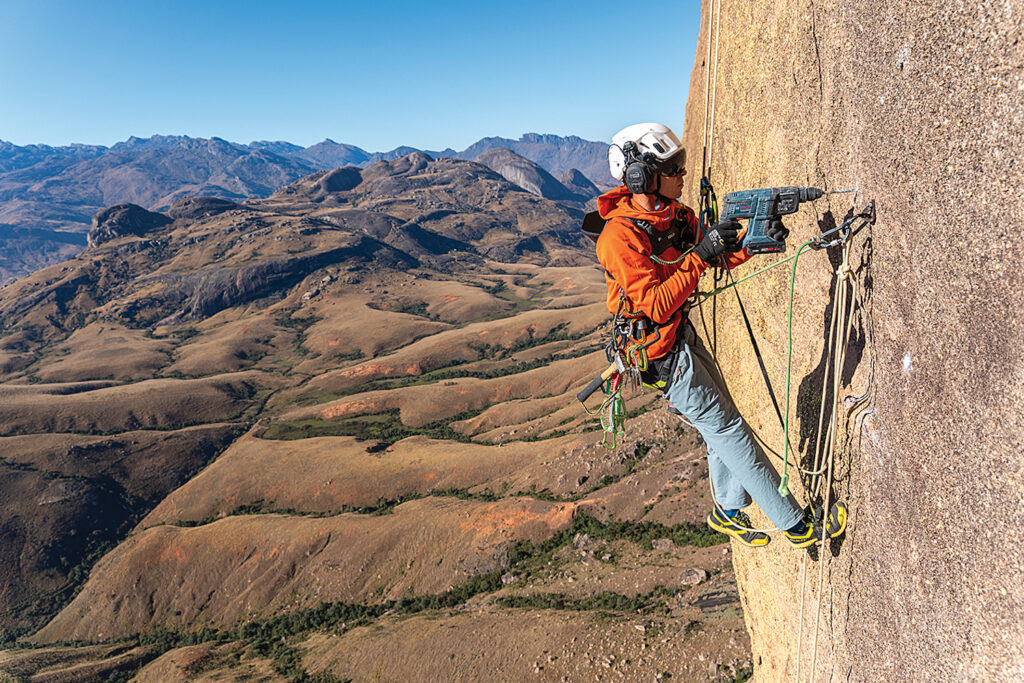
ALONG WITH LOCATIONS in Europe and Patagonia, in the last few years the tall, crackless granite walls of Madagascar have emerged as a high-profile place where the past collides with the future.
When Lynn Hill established Bravo Les Filles (5.12c A0 or 5.13d, 600m) with Nancy Feagin, Kath Pyke and nineteen-year-old Beth Rodden in 1999, it was hailed as a historic effort; “probably the most difficult rock climb ever put up by a team of women,” Hill wrote in The American Alpine Journal. They spent two weeks on the wall, going ground up, route finding and drilling more than fifty bolts. They hauled loads of gear and camped on the wall for several of the days. By the last day Hill had freed nearly every ropelength except for Pitch 8. She could do the moves but was too exhausted to link it all together. The route was eventually freed by Eneko and Iker Pou at 5.13d in 2004. And just last year, Sasha DiGiulian and Marianna Ordóñez completed the first female free ascent of the route.
Daniel Gebel and Dörte Pietron were also in Madagascar in 2025 with the intention to try the region’s testpiece route, Mora Mora (5.14b, 700m). First established in 1999, the route saw its first free ascent in 2010, by Adam Ondra, followed by DiGiulian and Edu Marin in 2017. But Gebel and Pietron, and another team, called off their attempts when they saw the poor condition of the bolts—they were corroded and didn’t follow the line of the free climbing. There were also empty holes where removable bolts had been used on the first ascent.
Instead, following DiGiulian’s ascent of Bravo Les Filles, Gebel and Pietron climbed that route in a three-day push. They also brought a drill to upgrade some rusty belay anchors and added three bolts to the last pitch, after conversations with Hill and DiGiulian, to allow for a direct finish.
Gebel and Pietron tell me that Bravo Les Filles was not a fun route to climb, as the original ground-up effort resulted in bolts being placed off route and in places that were hard to see or hard to clip.
“In a flaky face, where you can climb more or less everywhere, bolts are also important to show the direction of the line,” Gebel says. “In this case, good style is to place a bolt where it can be seen from the one before.… It is a good route that shows how bad bolting can damage a line.”
However, Gebel agrees that this doesn’t detract from what Hill’s team accomplished in 1999. As a team of women working to prove themselves in a male-dominated sport, had they bolted the route on rappel they would’ve surely been discredited, based on the ethics of the day that valued boldness and a ground-up style. Beyond that, the best practices for bolting quality lines were still being figured out. Visit nearly any sport crag with routes from the 1980s and ’90s, and you will find similar examples of poorly placed hardware and poor materials, or at least a history of such problems that have since been fixed.
What are we preserving for the future, and for whom?
In any case, Gebel and Pietron’s experience on Mora Mora in 2025 led them to return this year to re-bolt that route, with permission from the first ascensionists, Francisco Blanco and Toti Vales. Gebel and Pietron did their best to maintain the character of the climb, mostly just upgrading the hardware and moving some bolt placements to facilitate the actual line of the free climbing, which was done with input from previous ascensionists. It’s worth highlighting that transporting all the bolts, hangers, drills, bits, batteries and more to a remote place like the Tsaranoro Valley and hauling it up a wall amounts to a lot of trouble and expense before the real work even begins.
Once that work was done, the pair had ten days left to climb the route. Pietron redpointed all of the pitches on her first attempt during a two-day push.
PIETRON AND GEBEL have been busy applying the philosophy of crafting routes for the future to objectives near their home in Germany as well. On Riffeltorkopf, a lesser-visited crag that sits up high in a valley, they recently completed a six-pitch 7c (5.12d) that stands apart from the other routes, which are concentrated in the 8b (5.13d) range. All of these were established ground up by Gebel and Pietron, but this time they strayed from that approach. Gebel says that had they gone bottom-up, their efforts would have likely resulted in another 8b route, because finding the easiest path “on a vertical limestone slab with no obvious structure” while climbing up from below is nearly impossible.
“These are amazing routes, but they are too hard for most people,” Gebel says. Breaking from the conventional style of the area, they established their route from the top down. Anticipating criticism of their tactics, the name of the route is Profiempörer—“a made-up German word that could be translated to ‘professional moaner,’ ” Gebel says.
Gebel and Pietron are among a new age of developers who are thinking critically about the best hardware and development strategy for each unique location. While they still enjoy exploring new routes from the ground, their work isn’t over after they reach the top. They feel a responsibility to improve the route for future ascents, removing loose blocks, cleaning dirt and vegetation from cracks, and sometimes adding or moving fixed anchors where they could not place them on the onsight effort.
“Going ground up is a personal adventure, the coolest part,” Gebel says. “But going top-down always yields a better result.”
Any article on these topics would be remiss not to mention the legendary Swiss climber Michel Piola, who has been doing this work for decades, in the Alps and abroad, including putting up notable routes in Madagascar since the late 1990s.
“You cannot be a first ascender and not be influenced by Piola,” says Gebel, whose role models also include Yves and Claude Remy, and Rolando Larcher.
The 2014 film A Passion for New Routing features Piola revisiting some of his alpine routes to update fixed anchors and clean the rock. In one case, he replaces only two bolts instead of five, removing the other three, because small modern cams allowed the pitch to be naturally protected in a way that wasn’t possible when he established the line in 1990.
“The person bolting needs to be in tune with the people who come afterward,” Piola says in the film. “The route should take into account who is going to climb it. You have to be a bit altruistic and not too selfish.”
THIS PAST SEASON IN PATAGONIA, Myles Moser, Trevor Anthes and Harry Kinnard completed a route on the Torres del Paine that they named Paradigm Shift (VII 5.12+ A2, 1200m). At first glance their siege tactics appear antithetical to modern alpine style, as they used many fixed ropes and stocked camps before eventually committing to the wall in capsule style. But once there, they stayed on the wall from January 22 to March 2. Their goal was not to merely reach the top by any means, but to create a route that will offer the highest-quality free climb.
In a two-part interview on The Climbing Majority podcast, Moser and his partners recount waiting out storms, close calls while cleaning loose blocks, barely summiting on February 24, and then cleaning up the tons of gear for days on their way down. They also went to great lengths to pack out every bit of trash from their base camp, including their human waste. On the podcast Moser asserts the only remnants of their passage are the thoughtfully placed anchors they left on the route.
Fay Manners and her partners used a similar style to establish a thirteen-pitch route they named Apollo 13 (5.12+) on El Cohete in northern Patagonia in 2025. “When I arrived, I wanted to climb in alpine style,” Manners writes in Alpinist 90. “But this wasn’t the way to climb here, and it wasn’t the way to establish a repeatable route.”
Such practices hearken back to those adopted by Ron Olevsky while establishing new routes in Zion starting in the late 1970s. He would leave some pitons fixed and use “constructive scarring” on the soft sandstone cracks so that removable protection could be used on later ascents, thus preserving the rock.
“We want to maximize happiness and reduce sadness while still leaving room to be brave,” Gebel tells me. “Are ethics from thirty-plus years ago still the best? At the moment, the first ascensionist still has the most say in how the route is done. Is that sustainable? We want to change that.”
In Issue 50 (2015), the late Kyle Dempster expresses a similar set of values, but with one key difference regarding bolts:
Alpinism is increasingly the blend of mediums. Our practice in boulder fields and at sport crags has enabled us to climb harder on cold, high mountains. Yet we must be careful when ethical practices are blurred. Let’s keep our bolts at the crag, and let’s vow to leave the mountains clean and wild. As visitors, we must learn to look beyond our individual intentions to a larger web of responsibilities, one that includes cooperating with local communities. For we, too, are merely torchbearers for the future.…
The road ahead is still in question, and I wonder, what will it become? The light, as I hope future climbers will discover, lies deep within ourselves. Alpinism, at its best, remains that simple movement through the hills with the brothers and sisters we love.
What are we preserving for the future, and for whom? Like everything to do with climbing, there may be occasional fixed gear, but there is rarely a fixed answer to these questions as more climbers from different backgrounds visit places that were once remote. Even more reason to proceed with great care.
The way you establish a route can say a lot about who you are, as well as what you value and hope to impart to the future. That’s why I tend to view each route like a work of art.
[Edits were made to this article after print publication to clarify that Daniel Gebel and Dörte Patron had also established the other routes at Riffeltorkopf ground-up before adding Profiempörer in top-down style.—Ed.]